Phainopepla

Phainopepla
Phainopepla
Showing posts with label kestrel. Show all posts

Wednesday, January 11, 2012

Little Desert Delights

Yuma is on the western edge of the Sonoran Desert, in the Lower Colorado River Valley subdivision, the largest, hottest and driest of the six subdivisions.  Vegetation is much sparser here than in the Arizona Upland in which Tucson is situated, and is dominated by creosote bush (Larrea tridentata).  Saguaros are rare, except for those planted in landscapes, but along the washes can be found palo verde, ironwood and mesquite trees which provide habitat for a wide variety of birdlife.  The Colorado itself as well as man-made ponds and lakes give a home to many species of waterfowl.  While visiting our wintering Yuma friends for our annual New Year's celebration,  it was fun to observe the different species of birds who also winter in the mild Yuma temperatures.  On the golf course ponds we saw a large group of hooded mergansers, led by the stunningly beautiful male.  Cinnamon teals, pied-billed grebes, American wigeons, and egrets.  In the trees were flocks of Western bluebirds, and an American kestrel called loudly from his perch on a rooftop.  I was delighted to see dozens of monarch butterflies, which appeared to be wintering in the non-native trees.

Walking along a wash, we saw verdins, Gila woodpeckers, white-crowned sparrows, Say's phoebe, mourning doves and tiny ground doves.  Large millkweed vines grow up into the ironwood trees, attracting queen butterflies, and some of the seed pods were covered with the colorful milkweed bugs.


Near the end of our walk, a bird swooped low over our heads and flew to a perch across the road.  We were both delighted to see a male kestrel, and for our further enjoyment, he flew back to a nearby flagpole, where he sat and gave us a perfect view of his colorful plumage.


We got one more flyover as he moved to a palm tree and perched patiently in the shade of the large fronds.


I hung a hummingbird feeder just outside the kitchen window of our trailer, and by the second day of our stay, a male Costas was happily feeding regularly there.  He would perch in an ocotillo only a few feet away from the feeder where he could keep a good eye on it.  I felt bad when it was time to leave and take down the feeder, so we hung one in the ocotillo, hoping he would find it.

As we arrived back in Tucson, the weather continued to be unseasonably warm.  Can't say as I mind 78 sunny degrees on a January day!  And neither did this red-tailed hawk who soared above our house, then settled for a rest on a utility pole in the wash at the bottom of our driveway.


At our request, Tucson Electric Power has added raptor protection to some of its poles, and this raptor, for one, is very thankful!

I was happy to be back at the Desert Museum on January 6th, visiting with my friends and fellow docents, sharing the desert's secrets with visitors, seeing the hummingbirds already nesting in the aviary, delighting in the new blooms, and catching up on all the activity.

Red Barberry in Bloom (Berberis haematocarpa)
Baja Fairy Duster (Calliandra californica) - a hummingbird favorite

Ripening berries of the desert mistletoe (Phoradendron californicum)
The mountain lion was basking in the sun, napping on a warm rock, blending almost perfectly with the rock's tawny shade.  One visitor looked and looked where I was pointing, and simply could not see the cat!


A few butterflies are still flying at this time of year, including a lovely painted lady (Vanessa cardui) who was nectaring on the few lantana blooms that had not been hit by the freeze in December.


There's nothing like ending our day at the black-tailed prairie dog exhibit, whose occupants are endlessly entertaining.


Back in the neighborhood, phainopeplas spend the winter in our low desert, feasting on mistletoe berries, flashing their bright white wingbars in flight, and I see them daily in my back yard and on my walks around the neighborhood.


Mornings and late afternoons are the busiest times for hummingbirds at the feeders.  They come and go constantly, chasing one another, calling, perching for a minute, zipping by, then returning for another drink.


This is a female, probably Anna's, although I cannot see any red on the throat, so maybe she's a juvenile.

As the sun set on Sunday, the Catalina mountains lit up with a rosy hue, and the clouds matched them in vibrancy.


In a few moments, the night's real show began as the huge full moon edged over the Catalina's ridgetops.


Rapidly the orb rose and lit the landscape, while a few clouds began to encroach.  Such a powerful scene!


Sometimes we bemoan the lack of interesting wildlife and plant activity in January.  Oh, how I beg to differ.  Delightful little moments await around every corner.  Take a look.  You'll see.

Saturday, December 17, 2011

Hectic Days, Peaceful Moments

The days seem so hectic this time of year, even for people like me who don't do a lot of decorating or entertaining for the holidays.  There are gifts to buy, cards to send, parties to attend, baking to do, packing to finish, the stores are busy, the pace is frantic, the too-loud-recorded Christmas music is relentless.  Yes, it's easy to get negative about the whole affair.  So, moments of calm and beauty are all the more welcome and appreciated.

We've had a lot of rain this week, which is a good thing.  The desert loves it, and the hope of a marvelous spring display of wildflowers grows with each rainy day. Our biseasonal rainfall is what sets the Sonoran Desert apart from the 3 other North American deserts.  It's what gives us our tremendous biodiversity.  In the midst of a rainy Monday, the sun broke through the clouds and a brilliant rainbow lit the sky, it's faint double rising by its side.  Photos, at least mine, never really do justice to rainbows.  It's one of those things you just have to see for yourself.


  At the Fourth Avenue Street Fair last weekend I purchased a new hummingbird feeder from the artist who makes them and who is also a zookeeper at the Desert Museum.  Not only are they beautiful, but have the added advantage of being bee-proof.


I hung it near the old feeder and it didn't take long for the hummers to find it.


In the winter, I can count on two species of hummingbirds being here every day - Costa's (Calypte costae) and Anna's (Calypte anna).  One male Costa's in particular seems to have some kind of affinity for me, which started when he was younger and has continued into adulthood.  Frequently when I go out to the back yard, which is his territory, he flies right up to my face and looks at me, then sometimes moves around to my ears or neck, flying so close that I can feel the breeze from his wingbeats.  Here is his photo, for which he posed so patiently.


The fog descended again this week, shrouding the desert in mystery and ghostliness, lasting only for a few brief hours before lifting and allowing the sun to do its job.


That's our house at the top of the hill.  Can you see it?


As the blue sky returned, the clouds sat below the mountaintop.  This is the front range of the Santa Catalina Mountains, as seen from my front yard.


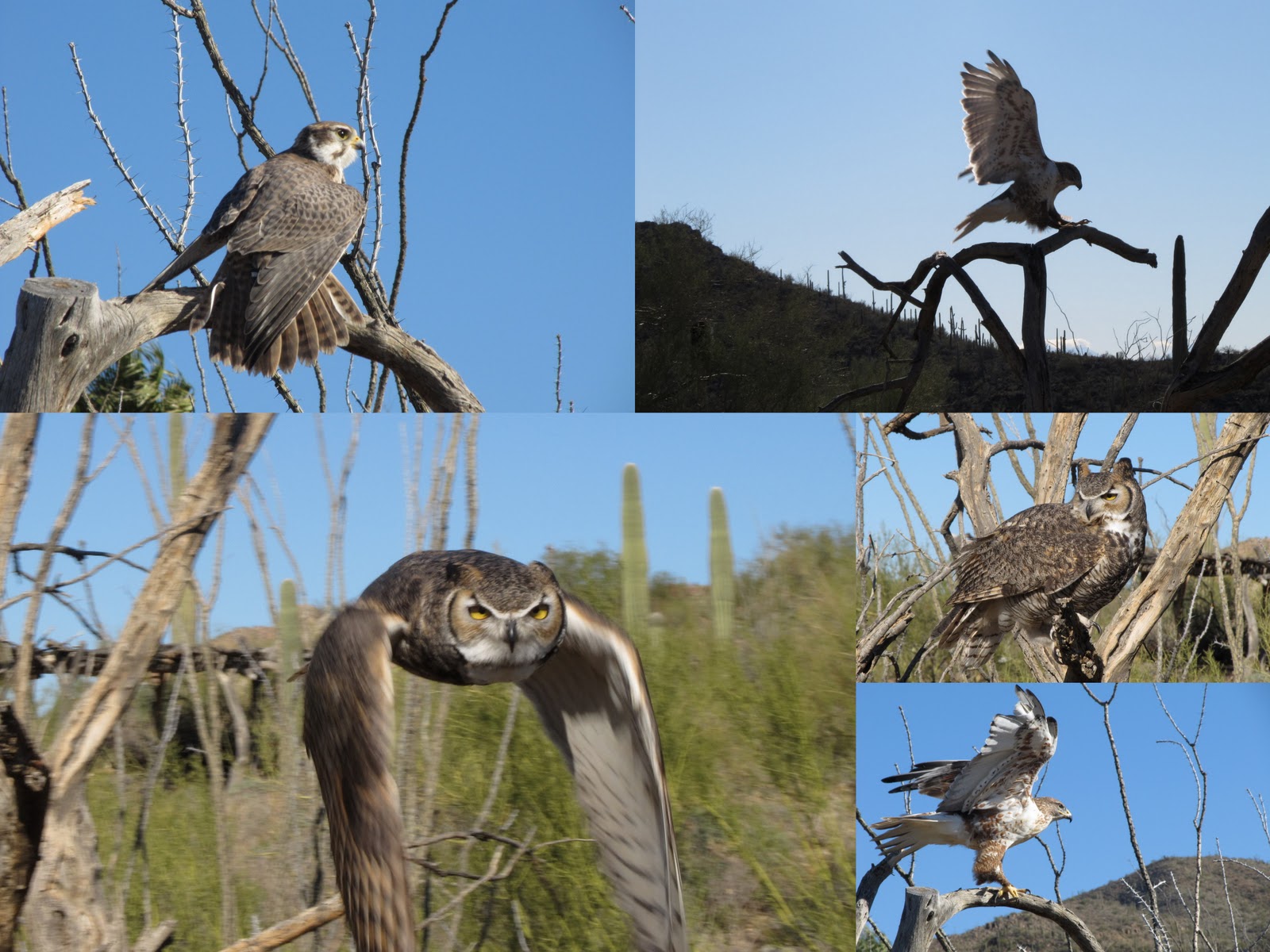
There is never a bad day at the Desert Museum.  With the chilly weather on Friday morning, most (maybe ALL) the visitors were at our premier daily event, Raptor Free Flight, showcasing several species of Sonoran Desert raptors flying free and offering eye-poppingly-close views and encounters.


Flying this morning were a great horned owl, a prairie falcon, a ferruginous hawk, a gray hawk and Chihuahuan ravens. It was a birdy morning as my next assignment was interpreting a female American kestrel, North America's smallest falcon.


As the day warmed, the crowds grew.  For my afternoon tour of the grounds, I was joined by four visitors, one couple from the Netherlands and one couple from Washington state.  The perfect size tour, in my opinion,  And these visitors in particular were a joy to tour as their interest and curiosity were endless. We stopped to examine every new plant and talk about its adaptability to the often harsh desert environment, and laughed at the antics of the cactus wren.  The mountain lion lounged in her viewing window just a few feet from us, looking for all the world like you could reach out and pet her.  The time passed much too quickly.  Now I think we have four more desert ambassadors!

Back in my yard, I was thrilled to see a flock of Western bluebirds stop by for a drink and a rest on their way to .  .  . ?  Where?  Somewhere warmer, I imagine.


Many thanks to those of you who follow this blog publicly, and to all my faithful readers.  I appreciate your time and your comments!


There are many reasons and ways to celebrate at this time of year.  I wish you joyful celebrations and tranquil, beautiful days all through 2012!

Here is a link to my holiday photo card.  It is a large file, so please give it sufficient time to download before scrolling (a minute or two depending on your speed):  Holiday Greetings

Cheers!