Phainopepla

Phainopepla
Phainopepla
Showing posts with label hummingbirds. Show all posts

Sunday, March 16, 2014

Sunday Chronicle


 .  .  . or  that was the week that was.

No Room at the Table
Around 6 in the evening, there is a literal feeding frenzy at the hummingbird feeders, and the birds' normal competitiveness gives way to cooperation.  I now have one feeder in the front of the house, and five in the back.  Each bird has its favorite, but they seem to use them all at various times.  The resident hummers here are Anna's and Costas, but during migration I might also see black-chinned, broad-billed, broad-tailed and rufous.  One time, several years ago, I was even privileged to have a rare violet-crowned spend a couple of weeks in my yard.  

Quite near the hummingbird feeder hangs a hollowed-out gourd that has been used by nesting house finches for several seasons.  Recently I've noticed a female house finch making many forays to the nest and the other day, after seeing her leave, I took a peek inside and saw a little face looking at me.


Baby House Finch in the Nest

The first-to-bloom cactus in my yard is this little claret cup - a form of hedgehog cactus, Echinocereus coccineus (triglochidiatus), and the only cactus in Arizona that is adapted for hummingbird pollination.


It grows naturally on rocky cliffs and gravelly slopes in oak and pine-oak woodlands and mixed conifer forest, so is not common at this elevation.

It's certainly not a great wildflower year, but around the neighborhood I have spotted a variety of blooms.

Desert Marigold (Baileya multiradiata)
Brittlebush (Encelia farinosa)


Twining Milkweed Vine
Desert Zinnia (Zinnia acerosa)


Fairy Duster (Calliandra eriophylla)
Desert Globemallow
Chicory or maybe Tackstem?
Milkweed

Ocotillo and Carpenter Bee

The beautiful Harris' hawks are seen every day, and appear to be nesting again in the neighborhood, which makes me very happy.  Yesterday a female flew right over me with a meal in her talons.  She landed on a utility pole and commenced dining.  Her companions continued to circle overhead, hoping, perhaps, to share in the meal.  One of the birds was a very different color, so I'm guessing he was still quite young.


Here's hoping your week is full of interesting and beautiful sights!

Sunday, July 14, 2013

A Color Burst

It was a lazy Saturday morning and I was in sloth mode.  I hadn't even taken my usual walk around the 3-mile neighborhood loop.  If you've ever seen the sloths of Central America, you know that their favorite 'activity' is just hanging out, usually sleeping.  To quote National Geographic, "The sloth is the world's slowest mammal, so sedentary that algae grows on its furry coat."  Rather than in a tree, I had perched myself in a comfy chair on the patio to enjoy the glorious, but all-too-brief show of the trichocereus cactus blooms in the garden.  Big puffy clouds kept the sun at bay and the temperature in the quite pleasant range. 

 
Trichocereus, also known as hybrid torch cacti, are popular with gardeners in Tucson for their huge, brilliant blooms.  Hybridized from tropical species, they are fairly cold tolerant, asking only for a bit of filtered shade and an occasional splash of water.  I have a collection of perhaps twenty plants in my Jardín Cactita, the little cactus garden.  A paltry number compared to the Desert Museum's large collection.


Cactus bees come to gather the abundant pollen and nectar, and pollinated plants will produce large, round fruits filled with tiny seeds. Being hybrids, it's doubtful that the seeds are viable, but I should ask a knowledgeable grower about this.  I might try growing some new plants from seed.
 
 
 For the most part, the blossoms only last one day, closing up by late afternoon, never to open again.  A couple of the species, however, produce flowers that will open for a second day.  Thus, it's important to take advantage of the event, drop what you had planned and simply enjoy!


Flower anatomy is primarily what determines the taxonomy of plants.  While it might seem obvious from looking at a plant that it is a cactus, that's not necessarily so.  Many non-cactus plants, for example, have spiny, sharp projections.  People often mistake some euphorbias, agaves and ocotillos for cactus.  Cactus flowers have a multi-lobed stigma (the white, or cream, structure in the center of the photos, the female part) and many stamens (the male, pollen-carrying structures deeper in the center). 

So, I was sipping my coffee, taking photos, enjoying the flowers and watching the hummingbirds zip around.  My year-around hummers are Costa's and Anna's and I am so accustomed to the sounds they make. 
 
 
So, when a new sound entered my consciousness, I looked quickly around to see one of the Anna's being chased by .  .  . a rufous??  Wow, what a surprise!  There was no doubt - the lovely rust-colored wings, the orange-red iridescent throat, and that famous rufous aggressiveness.  Even with my camera in my hand, I was too dumbstruck to take a photo.  Not that he would have slowed down long enough anyway.  The birding experts say the male rufous migrate early, but THIS early?  Oh, that was exciting.  The rufous made a couple more speedy passes by the feeder but never stopped to drink.
 
No sooner had I calmed down than another hummingbird flew right by my face and it was a blur of color that only registered as blue.  Blue?  Sure enough, a few moments later a better view revealed the red beak and the brilliant colors of a male broad-billed.  What a crazy day!  Flying flowers competing with the torches. 
 
A desert spiny lizard came out and posed with the flowers. 


Some Gambel's quail stopped by the snack bar.
 
 
And those flowers just kept on blooming.


Maybe every day should be a sloth day!  I won't get nervous until I start to see the algae grow.

Saturday, December 17, 2011

Hectic Days, Peaceful Moments

The days seem so hectic this time of year, even for people like me who don't do a lot of decorating or entertaining for the holidays.  There are gifts to buy, cards to send, parties to attend, baking to do, packing to finish, the stores are busy, the pace is frantic, the too-loud-recorded Christmas music is relentless.  Yes, it's easy to get negative about the whole affair.  So, moments of calm and beauty are all the more welcome and appreciated.

We've had a lot of rain this week, which is a good thing.  The desert loves it, and the hope of a marvelous spring display of wildflowers grows with each rainy day. Our biseasonal rainfall is what sets the Sonoran Desert apart from the 3 other North American deserts.  It's what gives us our tremendous biodiversity.  In the midst of a rainy Monday, the sun broke through the clouds and a brilliant rainbow lit the sky, it's faint double rising by its side.  Photos, at least mine, never really do justice to rainbows.  It's one of those things you just have to see for yourself.


  At the Fourth Avenue Street Fair last weekend I purchased a new hummingbird feeder from the artist who makes them and who is also a zookeeper at the Desert Museum.  Not only are they beautiful, but have the added advantage of being bee-proof.


I hung it near the old feeder and it didn't take long for the hummers to find it.


In the winter, I can count on two species of hummingbirds being here every day - Costa's (Calypte costae) and Anna's (Calypte anna).  One male Costa's in particular seems to have some kind of affinity for me, which started when he was younger and has continued into adulthood.  Frequently when I go out to the back yard, which is his territory, he flies right up to my face and looks at me, then sometimes moves around to my ears or neck, flying so close that I can feel the breeze from his wingbeats.  Here is his photo, for which he posed so patiently.


The fog descended again this week, shrouding the desert in mystery and ghostliness, lasting only for a few brief hours before lifting and allowing the sun to do its job.


That's our house at the top of the hill.  Can you see it?


As the blue sky returned, the clouds sat below the mountaintop.  This is the front range of the Santa Catalina Mountains, as seen from my front yard.


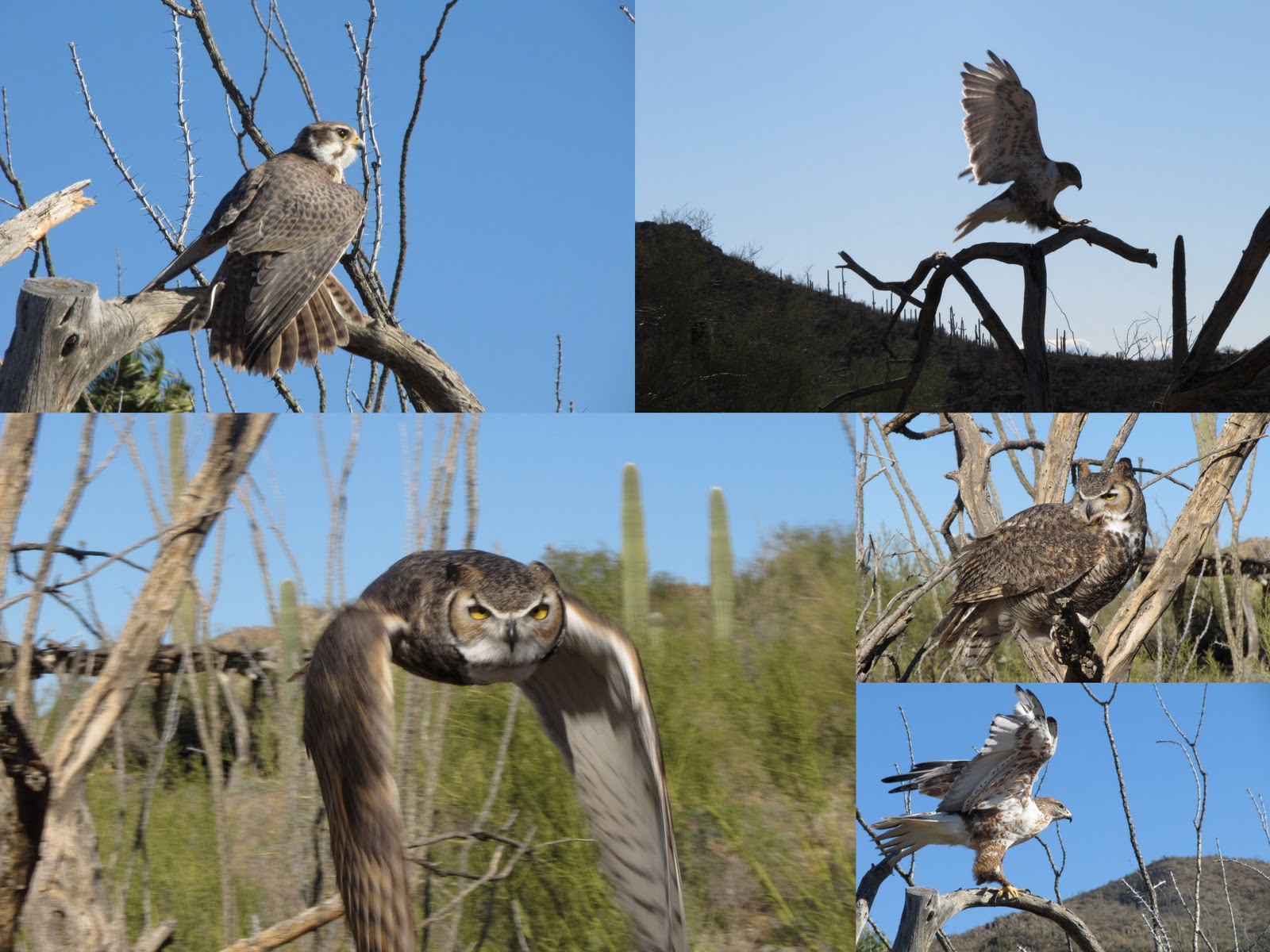
There is never a bad day at the Desert Museum.  With the chilly weather on Friday morning, most (maybe ALL) the visitors were at our premier daily event, Raptor Free Flight, showcasing several species of Sonoran Desert raptors flying free and offering eye-poppingly-close views and encounters.


Flying this morning were a great horned owl, a prairie falcon, a ferruginous hawk, a gray hawk and Chihuahuan ravens. It was a birdy morning as my next assignment was interpreting a female American kestrel, North America's smallest falcon.


As the day warmed, the crowds grew.  For my afternoon tour of the grounds, I was joined by four visitors, one couple from the Netherlands and one couple from Washington state.  The perfect size tour, in my opinion,  And these visitors in particular were a joy to tour as their interest and curiosity were endless. We stopped to examine every new plant and talk about its adaptability to the often harsh desert environment, and laughed at the antics of the cactus wren.  The mountain lion lounged in her viewing window just a few feet from us, looking for all the world like you could reach out and pet her.  The time passed much too quickly.  Now I think we have four more desert ambassadors!

Back in my yard, I was thrilled to see a flock of Western bluebirds stop by for a drink and a rest on their way to .  .  . ?  Where?  Somewhere warmer, I imagine.


Many thanks to those of you who follow this blog publicly, and to all my faithful readers.  I appreciate your time and your comments!


There are many reasons and ways to celebrate at this time of year.  I wish you joyful celebrations and tranquil, beautiful days all through 2012!

Here is a link to my holiday photo card.  It is a large file, so please give it sufficient time to download before scrolling (a minute or two depending on your speed):  Holiday Greetings

Cheers!

Sunday, September 20, 2009

Of Bees, Bats and Hummingbirds

A little sugar and water in a feeder brings hummingbirds to my yard throughout the year.  Various species come and go, and some hang around all year.  Anna's with the bright red head and gorget and  Costa's sporting outrageous purple on the throat are the mainstays.  They are sometimes joined by Rufous, Black-Chinned, Broad-billed, and one very special winter by a Violet-Crowned.  There really shouldn't be any drama.  Just remember to fill the feeder every few days, sit back and enjoy the show, right?  Oh, the Gila woodpeckers like to hang on the feeder to get a free meal, and the tiny Verdins have figured out that some sweetness can be had from this odd-looking flower.  That I don't mind. 

But, last September, a lone bee discovered a nectar source beyond her wildest dreams and raced back to spread the news to the workers.  Soon the troops began arriving at each of the two feeders, one in the front of the house and one on the back patio.  Two hours later, the feeders had disappeard under a buzzing, roiling  mass of insects, drunk on the sweet bounty, climbing all the way inside and even drowing in the liquid.  Needless to say, the hummingbirds took one look and made other plans for their meal.  It was terribly distressing to watch the hummers go away frustrated. 

I tried all kinds of deterrents - moving the feeders, spraying the bees with soapy water and even insecticide, taking the feeders down for days at a time - all to no avail.  Finally, I took them down for the duration, however long that might turn out to be.  During day, that is. 

More drama.  Every fall, the nectar-feeding Lesser Long-Nosed Bats (Leptonycteris curasoae) are making their preparations for the long trip back to Mexico and their winter home.  They, too, have discovered how easy it is to get nectar from a hummingbird feeder rather than looking for night-blooming flowers.  They arrive at my house around 8pm expecting  to find a full feeder.  Being the accomodating host that I am, I want the fuzzy little fellows to be happy.  So I filled the feeders and hung them out for the night, retrieving the empty, sticky thing in the morning before the damn bees arrived. 

By the middle of October, the bats had moved on.  Every two weeks or so I would hang the feeders up again, testing for bees.  It would take the hummers a couple of days to come back.  But it was well into November before the bees were finally gone.  To where, I will never know.

Fast forward to September of 2009.  Almost to the day, one year later, I was so disappointed to see bees hovering around the feeders, a prelude to the onslaught.  How weird is that?  I decided there was no point in fighting those determined little buggers and just took the feeders down for the day, filling and putting them back up for the nighttime arrival of the bats.  I mentioned this aggravation to one of my fellow docents at the Desert Museum and she said, "Spray the feeders with Pam!" She works in a hummingbird banding program and said that all the feeders at the banding sites use this method to keep the bees away, while allowing the birds to feed.  Wow, such a simple solution.  It has worked perfectly.  The bees hovered around for the first few days, but would not land.  Now they don't even bother coming around. 

The bats are happy.  The hummingbirds are happy.  I am happy.  The bees are pissed.  Well, you can't please everyone.