Phainopepla

Phainopepla
Phainopepla

Thursday, January 5, 2012

Aaahh, the Beach!

We sit high on our perch, binoculars and camera at the ready, coffee in hand and reading material nearby, surveying our empire - the blue Pacific as far as we can see, dotted by hundreds of wetsuit-clad surfers bobbing endlessly, catching an occasional wave, pelicans cruising low over the waves, tiny peeps running as one from the encroaching water, beach walkers and children playing in the sand, the fitness-obsessed running up and down the nearby long stairway, a huge school of dolphins in a feeding frenzy, a crab tender checking his traps - then someone calls, "whale!" and all eyes scan for the telltale spout of a passing gray whale.    The binoculars reveal the giant creature coming to the surface, and perhaps his companions.  Such are lazy hours spent at our campsite by the beach every Christmas.  It has become something of a tradition to meet my sisters and their families at San Elijo State Beach in Encinitas, California for a lovely week of getting our ocean fix.


As the morning wears on, breakfast begins calling.  Oh, the choices!  We could walk over to Pipes for a huge burrito filled with eggs, sausage, avocados, salsa and cilantro.  Or we could stroll just down the campground to Bull Taco for some oyster street tacos.  Then there is always Swami's Cafe or the Potato Shack in Encinitas, requiring a longer walk, but a necessary one to burn all those calories.  Cook?  Why would we do that?  OK, Christmas morning does call for waffles, eggs and bacon, right after the gin fizzes!  A time to diet this is not.  


The beach requires some closer inspection and exploring, feeling the saltwater on the toes, finding a new bird or a lovely shell, laughing at the antics of the marbled godwits (don't you love that name?), whimbrels, willets and the tiny sandpipers.  One bird befuddled me, and I decided it could be a wandering tattler (another marvelous name!)  A solitary and unspotted spotted sandpiper foraged every day in the same spot, only joined occasionally by a snowy egret.  An osprey scooped a fish out of the surf and then was harassed unmercifully by two gulls trying to steal the meal.  A song sparrow sits on the bluff vegetation and sings his heart out.  My favorites, though, are the elegant terns, those comical characters with the punk hairdo, often loudly berating one another, or standing like soldiers facing into the wind.


Sisters at the Beach - Carole, Susan, Connie

Walking north to Swami's Beach, a world-famous surfing spot,  I ascend the stairs and go another block to enjoy some peaceful moments in the Swami's lovely meditation garden where benches are set among the lush vegetation overlooking the ocean.  Named for the Self-Realization Fellowship Retreat of Swami Paramahansa Yogananda, the gardens are free and open most every day.


If we can tear ourselves away from the beach, there are endless possibilities for interesting exploration, including the fun and funky coastal towns of Encinitas, Cardiff, Oceanside, Leucadia, Carlsbad and Solana Beach.  The San Elijo Lagoon, now with a beautiful new visitor center and miles of trails, beckons nearby.  There we see buffelheads and avocets, egrets, warblers, a night heron and a northern harrier flying low over the marsh.  A little farther afield is the Leo Carillo Historic Ranch, now a park being restored and developed by the city of Carlsbad.  Enchanting old adobe structures set amid acres of trails and lush vegetation provide an oasis in the sea of bustling city around it.


Although none of us are Christmas traditionalists, it's still fun to find a tree and decorate it with makeshift ornaments often gleaned from the beach, topped with a lobster shell and strung with a few shells and some seaweed.  Lights now adorn our camp spaces, and on Christmas morning we exchange silly gifts.  My husband cooks a turkey on the barbecue and we sit down to a more-or-less traditional dinner with a most amazing backdrop!


We have cousins living in the San Diego area so thought it would be fun to have them and families to dinner at the beach.  The weather could not have cooperated more, and it was a beautiful evening when all 14 of us sat down to dinner to toast our reunion and wish each other well for the New Year.


The sunsets, brilliant night sky and campfires provided each evening's entertainment.  For my sister, Susan, and me, who love photography, the setting of the sun, with its glorious reflection on the wet sand, outrageous colors and cool silhouettes is the best time of day.  Thanks to the photography gods for giving us digital technology!


We bid farewell to 2011 with sincere wishes to all of you for many moments of wonder and joy with friends and family in 2012!

Saturday, December 17, 2011

Hectic Days, Peaceful Moments

The days seem so hectic this time of year, even for people like me who don't do a lot of decorating or entertaining for the holidays.  There are gifts to buy, cards to send, parties to attend, baking to do, packing to finish, the stores are busy, the pace is frantic, the too-loud-recorded Christmas music is relentless.  Yes, it's easy to get negative about the whole affair.  So, moments of calm and beauty are all the more welcome and appreciated.

We've had a lot of rain this week, which is a good thing.  The desert loves it, and the hope of a marvelous spring display of wildflowers grows with each rainy day. Our biseasonal rainfall is what sets the Sonoran Desert apart from the 3 other North American deserts.  It's what gives us our tremendous biodiversity.  In the midst of a rainy Monday, the sun broke through the clouds and a brilliant rainbow lit the sky, it's faint double rising by its side.  Photos, at least mine, never really do justice to rainbows.  It's one of those things you just have to see for yourself.


  At the Fourth Avenue Street Fair last weekend I purchased a new hummingbird feeder from the artist who makes them and who is also a zookeeper at the Desert Museum.  Not only are they beautiful, but have the added advantage of being bee-proof.


I hung it near the old feeder and it didn't take long for the hummers to find it.


In the winter, I can count on two species of hummingbirds being here every day - Costa's (Calypte costae) and Anna's (Calypte anna).  One male Costa's in particular seems to have some kind of affinity for me, which started when he was younger and has continued into adulthood.  Frequently when I go out to the back yard, which is his territory, he flies right up to my face and looks at me, then sometimes moves around to my ears or neck, flying so close that I can feel the breeze from his wingbeats.  Here is his photo, for which he posed so patiently.


The fog descended again this week, shrouding the desert in mystery and ghostliness, lasting only for a few brief hours before lifting and allowing the sun to do its job.


That's our house at the top of the hill.  Can you see it?


As the blue sky returned, the clouds sat below the mountaintop.  This is the front range of the Santa Catalina Mountains, as seen from my front yard.


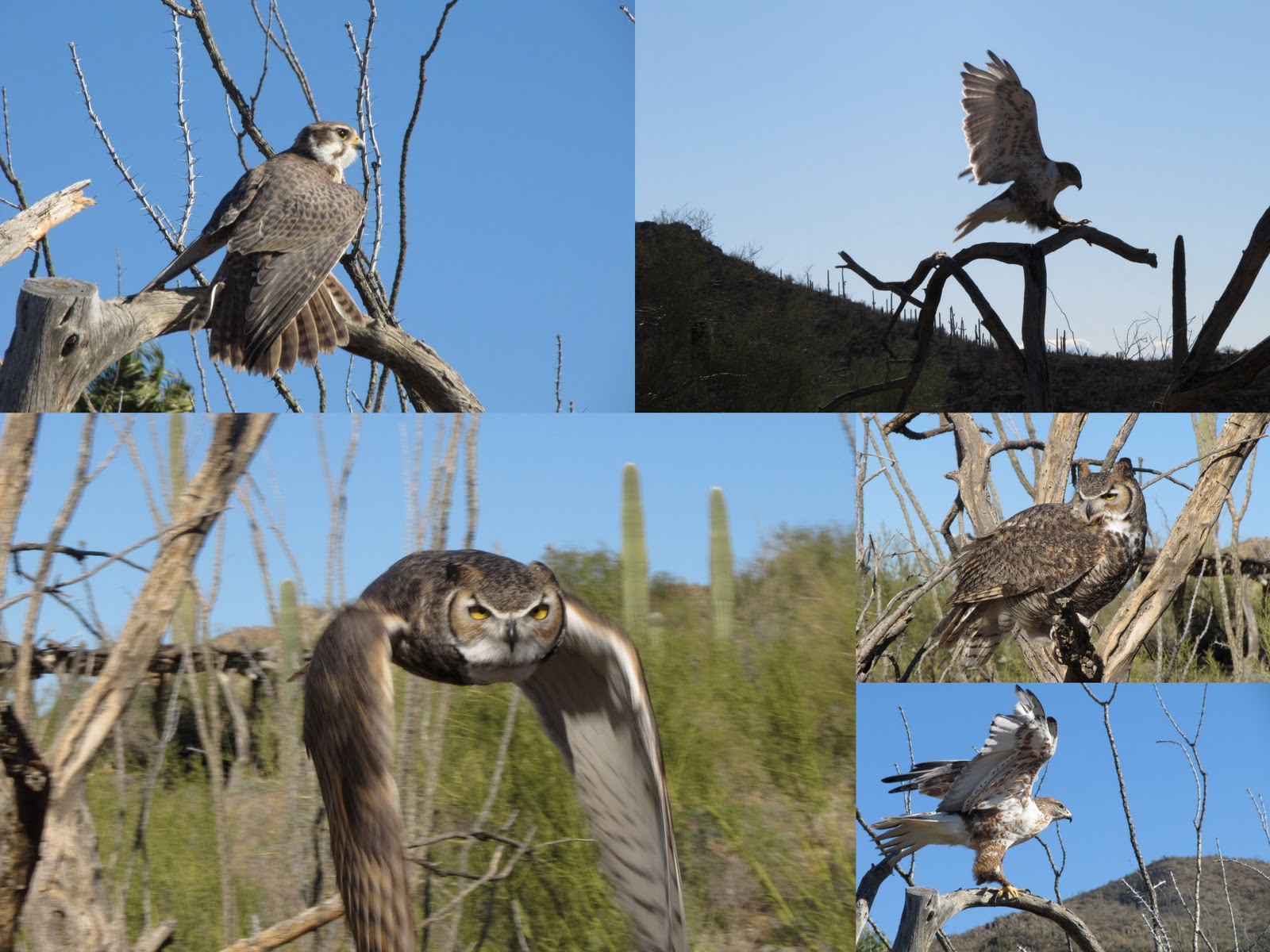
There is never a bad day at the Desert Museum.  With the chilly weather on Friday morning, most (maybe ALL) the visitors were at our premier daily event, Raptor Free Flight, showcasing several species of Sonoran Desert raptors flying free and offering eye-poppingly-close views and encounters.


Flying this morning were a great horned owl, a prairie falcon, a ferruginous hawk, a gray hawk and Chihuahuan ravens. It was a birdy morning as my next assignment was interpreting a female American kestrel, North America's smallest falcon.


As the day warmed, the crowds grew.  For my afternoon tour of the grounds, I was joined by four visitors, one couple from the Netherlands and one couple from Washington state.  The perfect size tour, in my opinion,  And these visitors in particular were a joy to tour as their interest and curiosity were endless. We stopped to examine every new plant and talk about its adaptability to the often harsh desert environment, and laughed at the antics of the cactus wren.  The mountain lion lounged in her viewing window just a few feet from us, looking for all the world like you could reach out and pet her.  The time passed much too quickly.  Now I think we have four more desert ambassadors!

Back in my yard, I was thrilled to see a flock of Western bluebirds stop by for a drink and a rest on their way to .  .  . ?  Where?  Somewhere warmer, I imagine.


Many thanks to those of you who follow this blog publicly, and to all my faithful readers.  I appreciate your time and your comments!


There are many reasons and ways to celebrate at this time of year.  I wish you joyful celebrations and tranquil, beautiful days all through 2012!

Here is a link to my holiday photo card.  It is a large file, so please give it sufficient time to download before scrolling (a minute or two depending on your speed):  Holiday Greetings

Cheers!

Monday, December 12, 2011

Bits of Life

Little, and not so little, things that occur every day are what make life so endlessly fascinating.  In so many ways, this was just a 'typical' week, and yet, looking back, I couldn't help but marvel at all those interesting little events.

Now, I wouldn't call this event little, so it leads off the parade.  Living in the open spaces of the West, we were treated to a spectacular view of the lunar eclipse.


My only complaint is that the moon reached the horizon before being totally covered with shadow.  Since the sun was rising on the opposite side of the sky, it wouldn't have been long before my view was obscured anyway.

The week began cold and rainy, with a touch of snow on the nearby Santa Catalina Mountains.  And Monday brought a heavy dose of early morning fog, creating a surreal atmosphere around the neighborhood.  And the perfect photo opportunity!


The cold nights persisted, but the days warmed up into the mid-60's.  Perfect hiking weather.  My friend and fellow docent, Marilyn, and I took this opportunity to hike the Ventana Canyon Trail on the front range of the Catalinas.  Our day began with another glorious sunrise, a good omen for the day..


The giant saguaros stood out against the blue, blue sky.


And the geology revealed itself in lovely patterns and colors.


The trail climbed steadily, sometimes steeply, through the typical saguaro-palo verde-mesquite vegetation, up into the agaves and sotols, little bits of color appearing in the blooming verbena and brittlebush, as well as some small shrubs with fall colors.  We heard canyon wrens and black-tailed gnatcatchers, curve-billed thrashers and black-throated sparrows and spotted them flitting from tree to tree.  A red-tailed hawk flew through the canyon and landed on top of a saguaro, the better to survey his surroundings.


At the ridgetop, the view of the canyon and the valley below was breathtaking.


The north side of the ridge revealed ferns and mosses, sotols, agaves, live oaks and massive granite rock formations.  Water has eroded the rock over the centuries, creating small pools that hold water most of the year.  Dubbed Maiden Pools, this is the perfect spot for lunch and a rest before starting back down the trail.


Just when you start to take this amazing plant life for granted, you spot a scene like this one:


Talk about adaptability!  This saguaro (and the prickly pear too) is growing out of solid rock.  And it's no youngster either.  My guess is that it is well over 100 years old.   Some chatter and movement in nearby trees revealed a pair of canyon towhees.  A dead saguaro made for an interesting sculpture.


The afternoon sun behind the canyon walls made for some cool profile views of the cactus.  Before we knew it, we were back in the parking lot, discussing our next hike.


On Friday, I was back at the Desert Museum for my weekly docent gig.  Once our assignments are over for the day, a number of us docents cruise around the museum, talking to visitors, looking for birds or bugs, or just enjoying the antics of the animals.

With the birth this spring of 14 pups, the black-tailed prairie dog exhibit now teems with activity and is a never-ending source of entertainment.


Not to be outdone, the mountain lions vied for "Most Gorgeous" of the day.


Our best bird sighting of the day was a spotted towhee, whose elusiveness proved impossible for photographs.  The rest of the bird list included Abert's towhee, Cooper's hawk, verdin, cactus wren, gila woodpecker, phainopepla, white-crowned sparrow, pyrrhuloxia, northern mockingbird, northern cardinal, Costa's hummingbird and more.

A burst of color had me reminding myself that it really is December.


May your week bring you some wonderful 'little' bits of beauty!

Tuesday, December 6, 2011

Friday at the Museum


I have the very great privilege of spending every Friday at the Arizona Sonora Desert Museum, talking to people from all over the world, and singing the praises of the Sonoran Desert.  Say the word "museum" and the picture that jumps to mind is a stuffy, deathly quiet, and, to some, boring indoor experience.  Throw that image out the window, and now picture a botanical garden, zoo, park, wildlife experience and art gallery all wrapped together.  To my mind, it is by far Tucson's premier destination.  There is never a shortage of photo opportunities or interesting experiences.  I invite you come along with me for a day at the museum.  I'll try to make this a more-or-less regular topic.

Friday, December 2nd dawned cold and overcast, with predicted rain and wind.  Not exactly the kind of forecast to draw people to the Desert Museum.   Arriving early, long before the museum opens at 8:30am, it's wonderful to walk the grounds and see what birds are about, what flowers are blooming, and anything new since last Friday.


There is a spot along the main path that offers a beautiful view of the early-morning sun as it filters through the clouds, the saguaros and ocotillos in the foreground.  I often stop here on my Friday morning walk-abouts to admire the scene and get the camera warmed up.  One of the zookeepers was just coming out of the large aviary, so I stopped to chat with her about hummingbirds.  She not only takes care of our hummingbird collection, but also makes beautiful and interesting feeders from copper.  An added feature is that this design is bee-proof, something very desirable after combating bees at my feeders all summer.


The red spines and yellow fruit of a barrel cactus (Ferocactus wislizenii) stood out against the greenery in the early morning sun, the dampness of an earlier rain intensifying the colors.

The museum opening came and went, and still there were no visitors.  Who could blame them?  It was cold out here!  The animals didn't mind, however, and they were all busy and active.  Having no visitors to talk to meant more time for photos.  I stopped by the coati (Nasua narica) exhibit and was delighted to see one individual hanging out in a tree and another drinking from the pond.  


These relatives of the racoon are great climbers and diggers.  The long tail is not prehensile and is used mainly for communication among the troupe.

 Up on the top of Cat Canyon a small bird drew the attention of my fellow docents and me as we watched it taking a bath in a small tinaja.  Finally we determined that it was a black-chinned sparrow, somewhat immature.  The first of this species we've seen at the museum this year.


Even in our fabulous hummingbird aviary, one of our most popular exhibits, I found myself alone with the tiny birds who were zipping around at crazy speeds, narrowly avoiding colliding with me.  Cold weather makes it more important that they get lots of energy.


Back on the main path, the distinctive whit-wheet call of a curve-billed thrasher ((Toxostoma curvirostre) drew my attention to the top of a nearby cactus.  What a feat (feet?) to be able to stand among all those spines!


The crowds picked up in the afternoon and I was surrounded by large groups as I introduced them to a beautiful female barn owl (Tyto alba).


The promised rain arrived, but lasted only briefly.  The saguaro interpretation was my last of the day, and one of my favorite assignments.  Who can come to the Sonoran Desert and not be interested in the unique and iconic saguaro cactus?


Across the museum grounds and out to the valley below, the sun once again sent its brilliant rays bursting through the clouds, creating a bookend to another magnificent day at the Arizona Sonora Desert Museum.