Phainopepla

Phainopepla
Phainopepla
Showing posts with label Desert Museum. Show all posts

Wednesday, April 9, 2014

Docent Diaries

No matter what my assignment, I love my docent duties at the Desert Museum.  Some jobs, however, are more fun than others.  For the past two years, my friend Mary Lou and I have been the Day Captains for the Friday Docents.  Which means we 'get' to spend most of our day in the office doing schedules, organizing the day, making coffee, entering data in the computer, being the in-charge people for all the docent activities for the day, cleaning up the office and lounge, and generally, as another friend put it, "herding cats".  (Just try getting them all together for a photo!) Managing people is always entertaining, frustrating, interesting and normally chaotic.  The reason we became docents, however, is to be out on the grounds of the Museum, talking to visitors and interpreting the Sonoran Desert.  Soon my captaincy stint will be over and I'll be back out doing the really fun stuff.

Here's what our group looks like this year.


There are four or five missing.  It's impossible to find a day when everyone is there, or makes it to the photo shoot on time.  But, this isn't bad.

 Mary Lou and I agreed that, no matter how busy we were, we would still take out our animals for one hour a day.  I am certified this year on Large Raptor, which means I can take out either a Harris' hawk or a barn owl.  We take them out in rotation, and on this day, it was a hawk.


Harris' hawks are a very unique raptor that we are privileged to have as permanent residents in Southern Arizona.  What sets them apart from most other birds of prey is that they are a social raptor, living together in family groups, hunting cooperatively, and all taking part in the nesting process.  The younger birds from the previous brood will assist the parents in guarding the nest and bringing food for the mother and the nestlings.  In each group, an alpha female will be dominant.  The bird I am holding is an adult male.  Males and females are colored alike, but what distinguishes them is size - the females are significantly larger.  For the past several years, I have had Harris' hawks nesting in my neighborhood, and I am now seeing the female on the nest once again.  Every day from October through April, the Museum flies a group of Harris' hawks in our Raptor Free Flight program.  It's a thrilling experience to have one of these big birds fly so closely over your head that their feathers so briefly and gently touch you.  Each year docent can choose which group of animals we want to interpret to the public.  We then go through training and certification to keep our skills current.  The Desert Museum is accredited by the AZA (Association of Zoos and Aquariums), which sets exacting standards for animal care and handling.

Mary Lou and I try to finish most of our duties by around 3pm, which gives us some time to go explore the grounds, talk to visitors, look for fun and interesting sights, and have a little 'play' time.  April is a good time to see butterflies, as well as their larvae and pupae.  Right now, the Pipevine Swallowtails are abundant in all forms.

These handsome guys are the larvae, feeding happily on pipevines,


Soon they will be forming a chrysalis and undergoing the amazing metamorphosis that will allow them to emerge in a totally new form.  Here's what the chrysalis looks like:

Pipevines have a strange little flower called the pipe.


Which is then followed by this fruit.

Sadly I do not have a suitable photo of the adult pipevine swallowtail butterfly, so please excuse me for borrowing a couple from one of my favorite sites, Firefly Forest

As she says, they are difficult to photograph as they seldom sit still.  I guess that's my excuse.  With their iridescent blue on the upper hind wings, and the array of colored spots on the lower wings, these large black butterflies are stunningly beautiful.

With our lack of rain and warm weather, everything seems to be happening a little earlier this year, like the cactus blooming.  All around the grounds, and out in the desert, little hedgehog cacti are sporting their gaudy pink finery, forcing me to stop and get yet another photograph.  Hedgehogs are a small, multi-trunked cactus, generally somewhat inconspicuous until bloom time.


Glorious too are the claret cups, which are another form of hedgehog cactus, and are one of the earliest to bloom.  They are just about finished now, but this one waited for me.


The Museum grounds are alive with dozens of species of blooming flowers, and it is inspiring to just stroll through the gardens and various habitats and take in the amazing palette.

Here are just a few more. Fairy Duster, yellow primrose, blackfoot daisy and California buckwheat.


Lastly, we stopped by to see the coatis, and watched a young Cooper's hawk watching us.


Ahhh, no wonder I long to spend the entire day out on the Museum grounds talking to visitors and just enjoying the theater. Soon, very soon, I'll be able to do that.  At my age, however, I do not wish to speed up time.  So I will enjoy every day as a docent at the Arizona Sonora Desert Museum, no matter what it brings.

May every day be one you treasure.

Wednesday, February 22, 2012

February Rocks

They say time flies when you're having fun, so I must be having a ball!  Where have the days gone?  First there was the trip to Bisbee, then the Gem and Mineral Show, out of town visitors to entertain, days at the Desert Museum, Super Bowl party, gardening, writing, neighborhood meetings and activities, political meetings, birding, hiking, photographing and golf.  Oh, now I see where they've gone.

So I'll do a little recap here.  First a note about the new gadget on the left.  Recently, Blogger's Word Verification has stepped up the difficulty of the words you must decipher before leaving a comment on a blog that has it enabled.  It was always a tad annoying, but now it's ridiculous.  The words are so convoluted that sometimes it takes me three tries to get it right, and frequently I give up in frustration and protest.  I've never had Captcha (Word Verification) enabled on my blog and have never (knock on wood) been plagued with spam.  I have begun seeing more and more blogs with the Word Verification Free signs and messages and I am now promoting that movement.  Please, be kind to your readers and don't make them work so hard to leave a message.

January, February and March are the Busy Season in Tucson, with snowbirds in town and lots of big events.  The biggest of them all is the Gem and Mineral Show which takes over the entire city for two weeks and attracts sellers and buyers from all over the world.  Huge white tents sprout like mushrooms in the forest and many motels are filled with room after room of all things gem, mineral, meteorite and fossil.  There is a cacophony of languages and food aromas, and so many delights for the eyes.  It's really hard to know where to start, and virtually impossible to see it all.

First came the Desert Museum's Mineral Madness, and of course I had to bring home a couple of great rocks. Mostly, I look for things that I can put in the yard, like a nice, large piece of petrified wood that I found in the Yard Rocks barrel, sold for a dollar a pound.
Great Prices on Minerals at ASDM's Mineral Madness

Then it was on to the big tents, outdoor vendors and finally to Tucson Gem and Mineral Society Show at the  convention center.  I didn't take any photos in the tents, but just imagine hundreds of booths selling everything from gold and diamond jewelry to huge amethyst geodes, giant meteorites to ancient fossils, gemstones of every type by the millions, tables heaped with pearls, beads, coral, jade, turquoise and agate.

The Desert Museum sponsors a booth at the TGMS show to promote the Museum and that's where I spent 4 hours on a Thursday morning, demonstrating our meteorite and mineral ID education kits and extolling the virtues of the Desert Museum.  After my shift I am free to roam the aisles on the floor of the show, taking in the amazing sights.  A wonderful feature of this show are the exhibits that always center around a featured mineral.  This year, in honor of Arizona's 100th birthday, the theme was Arizona minerals.  Famous for copper, Arizona is also known among mineral afficianados as the  producer of some of the world's finest azurite, malachite, wulfenite and turquoise.
Carole at the Desert Museum Booth


Bisbee Minerals

TGMS Show at the Convention Center

For the most part, this has been a very warm and dry winter.  Fine and dandy for our winter visitors and all the outdoor activities and events, but not so great for our wildflower display or the enduring drought.  Lizards have been seen scampering around as if it were spring and even a few snakes have ventured out of their winter dens.  Flowers are popping up everywhere and birds are busy building their nests.


My husband planted his vegetable garden this week, so far with tomatoes, squash and peppers.  We're hoping the threat of frost is past, although this morning was still in the 30's.


The Desert Museum is on just about every Tucson visitor's itinerary, which means that this is our busy season too.  There's a lot going on, with morning and afternoon Raptor Free Flight programs, new exhibits in the gallery, Running Wild and Live and (Sort Of) on the Loose in the theater, a morning bird walk, four tours,and many animal demos and docent talks throughout the day.

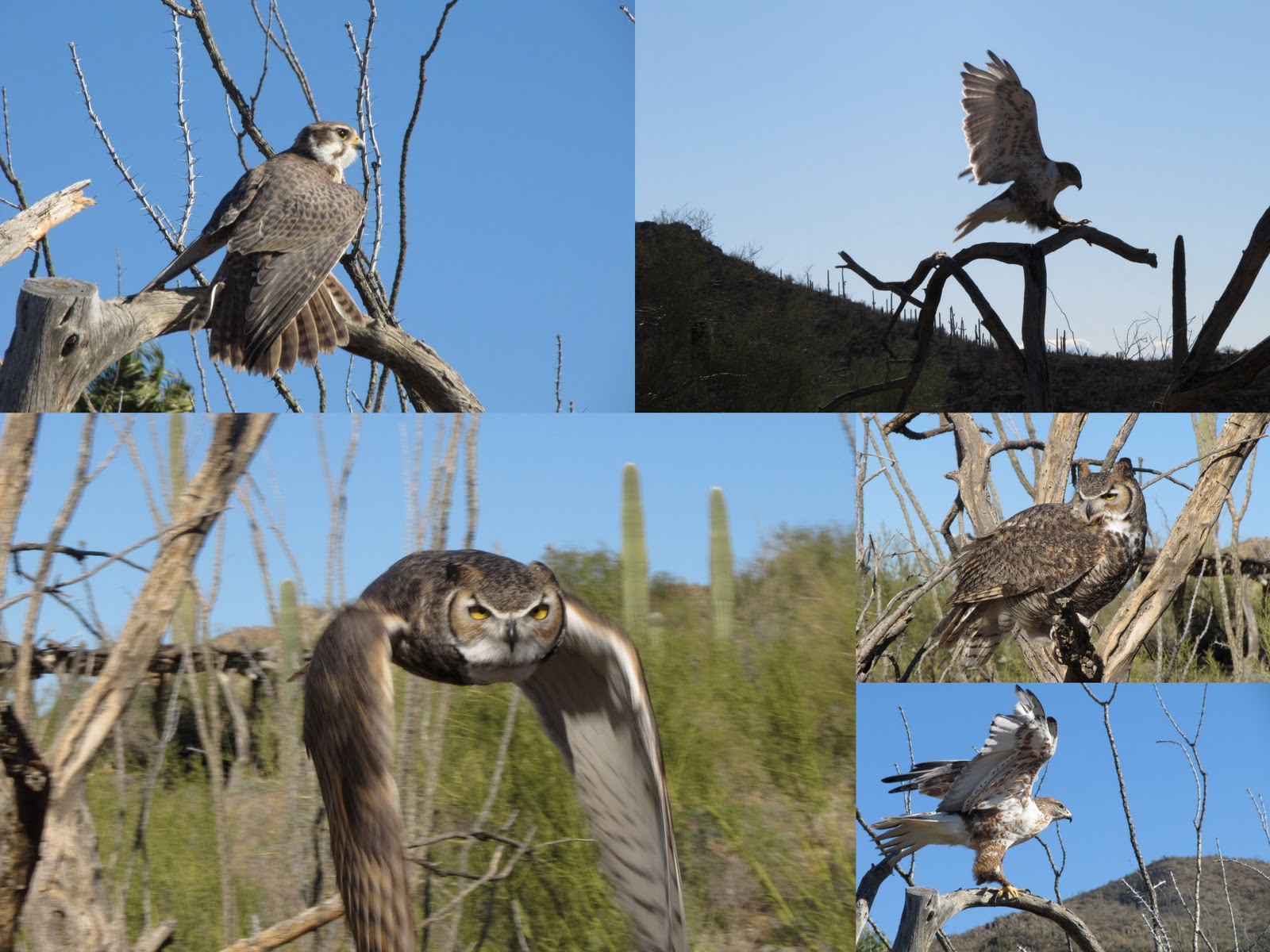
I'm always happy when my schedule allows me to attend the Free Flight programs and talk to visitors about the raptors and our amazing staff and volunteers who train and handle the birds. The morning program contrasts and compares some of the many raptors who call Arizona home - great horned owl, prairie falcon, gray hawk, ferruginous hawk, Chihuahuan ravens (not truly raptors, but pretty cool to watch fly) and red-tailed hawk.

Great Horned Owl comin' at ya!

Gray hawk, getting a little reward
The social and unique Harris' hawks take over for the afternoon program, flying so close to visitors that people dare not raise their cameras above their heads.  These beautiful birds hang together in family groups, hunting cooperatively and assisting one another in territory and nest protection.

Our longtime resident roadrunner has moved into new digs in the Life on the Rocks exhibit and seems to be adapting quite well, looking over his territory and interacting with visitors. The roadrunner is the state bird of New Mexico, not Arizona, and is a member of the cuckoo family.  Watch his antics for a while and that family connection will be easy to see.


On my 1:30 tour I only had four people, all part of one family.  The elderly man and woman had been to the museum before and were bringing his sister and niece out for a visit.  They specifically wanted to see the animals, so off we went to find them some.  Along the way we talked about jojoba and creosote bush, saguaro and barrel cactus.  They were troopers and hung in there with me for well over an hour and a half, interested in everything we discussed.  Close to the end, the woman asked if I could guess how old Henry was.  Well, he looked about 80, but was really 92!  Amazing!  We can only hope to be that agile and engaged at that age.

Since Friday was the first day of the Great Backyard Bird Count, I did my counting at the Desert Museum between all my other activities.  I got 17 species, which wasn't great but it will have to do.  There were lots of black-chinned, black-throated, white-crowned and Brewer's sparrows in one of the gardens, and the phainopeplas were courting.  Some of the usual suspects did not make an appearance for me, but I did see pyrrhuloxia and Abert's towhee, Anna's and Costa's hummers, cardinal, curve-billed thrasher, lesser goldfinch, verdin, Gila woodpecker, mockingbird and mourning dove.

Here's wishing you busy, happy days in February, and good endings to all your days!
The End

Saturday, December 17, 2011

Hectic Days, Peaceful Moments

The days seem so hectic this time of year, even for people like me who don't do a lot of decorating or entertaining for the holidays.  There are gifts to buy, cards to send, parties to attend, baking to do, packing to finish, the stores are busy, the pace is frantic, the too-loud-recorded Christmas music is relentless.  Yes, it's easy to get negative about the whole affair.  So, moments of calm and beauty are all the more welcome and appreciated.

We've had a lot of rain this week, which is a good thing.  The desert loves it, and the hope of a marvelous spring display of wildflowers grows with each rainy day. Our biseasonal rainfall is what sets the Sonoran Desert apart from the 3 other North American deserts.  It's what gives us our tremendous biodiversity.  In the midst of a rainy Monday, the sun broke through the clouds and a brilliant rainbow lit the sky, it's faint double rising by its side.  Photos, at least mine, never really do justice to rainbows.  It's one of those things you just have to see for yourself.


  At the Fourth Avenue Street Fair last weekend I purchased a new hummingbird feeder from the artist who makes them and who is also a zookeeper at the Desert Museum.  Not only are they beautiful, but have the added advantage of being bee-proof.


I hung it near the old feeder and it didn't take long for the hummers to find it.


In the winter, I can count on two species of hummingbirds being here every day - Costa's (Calypte costae) and Anna's (Calypte anna).  One male Costa's in particular seems to have some kind of affinity for me, which started when he was younger and has continued into adulthood.  Frequently when I go out to the back yard, which is his territory, he flies right up to my face and looks at me, then sometimes moves around to my ears or neck, flying so close that I can feel the breeze from his wingbeats.  Here is his photo, for which he posed so patiently.


The fog descended again this week, shrouding the desert in mystery and ghostliness, lasting only for a few brief hours before lifting and allowing the sun to do its job.


That's our house at the top of the hill.  Can you see it?


As the blue sky returned, the clouds sat below the mountaintop.  This is the front range of the Santa Catalina Mountains, as seen from my front yard.


There is never a bad day at the Desert Museum.  With the chilly weather on Friday morning, most (maybe ALL) the visitors were at our premier daily event, Raptor Free Flight, showcasing several species of Sonoran Desert raptors flying free and offering eye-poppingly-close views and encounters.


Flying this morning were a great horned owl, a prairie falcon, a ferruginous hawk, a gray hawk and Chihuahuan ravens. It was a birdy morning as my next assignment was interpreting a female American kestrel, North America's smallest falcon.


As the day warmed, the crowds grew.  For my afternoon tour of the grounds, I was joined by four visitors, one couple from the Netherlands and one couple from Washington state.  The perfect size tour, in my opinion,  And these visitors in particular were a joy to tour as their interest and curiosity were endless. We stopped to examine every new plant and talk about its adaptability to the often harsh desert environment, and laughed at the antics of the cactus wren.  The mountain lion lounged in her viewing window just a few feet from us, looking for all the world like you could reach out and pet her.  The time passed much too quickly.  Now I think we have four more desert ambassadors!

Back in my yard, I was thrilled to see a flock of Western bluebirds stop by for a drink and a rest on their way to .  .  . ?  Where?  Somewhere warmer, I imagine.


Many thanks to those of you who follow this blog publicly, and to all my faithful readers.  I appreciate your time and your comments!


There are many reasons and ways to celebrate at this time of year.  I wish you joyful celebrations and tranquil, beautiful days all through 2012!

Here is a link to my holiday photo card.  It is a large file, so please give it sufficient time to download before scrolling (a minute or two depending on your speed):  Holiday Greetings

Cheers!