Phainopepla

Phainopepla
Phainopepla
Showing posts with label birds. Show all posts

Saturday, May 31, 2014

Verde Valley Visit


I love to go exploring, whether it be across the world, or just across the state.  There's always something new to see. And so it was with this short trip to central Arizona's Verde Valley, where the upper Sonoran Desert meets the lush riparian oasis of the Verde River.  The Dead Horse Ranch State Park in Cottonwood was to be our home for a few days, and what a lovely one it was.  The park encompasses a section of the river as well as the desert above.  Our campsite sat on a hillside overlooking the valley and the town.


With water and electricity at the sites, a nearby town and excellent cell service, it's not exactly wilderness.  But the sites are huge and well-separated and there are many excellent trails leading right from the campground.  At close to 3500' in elevation, the desert vegetation is somewhat different than around Tucson, almost 1000' lower.  The saguaros have disappeared as have the barrel cacti, but I did see chollas, some prickly pear and hedgehogs.  The vegetation is dominated by crucifixion thorn (Castela emoryi), catclaw acacia (Acacia greggii), mesquite and juniper, as well as grasses, yucca, ephedra, ratany and more.  With the cooler temperatures, there were still some wildflowers blooming.

Strawberry Hedgehog Cactus (Echinocereus engelmannii)

Silverleaf Nightshade (Solanum elaeagnifolium)

Scarlet Gaura (Gaura coccinea)

Ratany (Krameria sp.)

Soaptree Yucca (Yucca elata)

Southwestern Ringstem (Anulocaulis leiosolenus)

Southwestern Ringstem (Anulocaulis leiosolenus)

Blackfoot Daisy (Melampodum leucanthum)

New Mexico Feathergrass (Hesperostipa newomexicana)

Red Three-awn Grass (Aristida purpurea)

Wrap-around views from the trails made every hike a treat for the eyes, and the camera.  Below us, the green ribbon of the Verde River's lush riparian corridor, across the valley, the scars of copper mining and the towns it created, all around in the near distance the quiet of the desert.  On a hilltop just a few miles away, the ancient ruins of a native pueblo, now preserved by the National Park Service as Tuzigoot National Monument.

Our travels included a visit to Tuzigoot to learn how the ancient peoples lived in this valley for centuries; to Jerome, perched perilously on the mountainside, old buildings that once served a big mining community now repurposed for galleries, shops, restaurants and inns; Old Town Cottonwood where we discovered an amazing array of quality restaurants; and to Sedona, land of the red rocks and vortices that has been overrun with people.  From Jerome, we spotted the huge plumes of smoke that could only mean wildfire.  We were to learn the fire was burning in beautiful Oak Creek Canyon, which runs between Sedona and Flagstaff.  It burns to this day.

The former mining town of Jerome


The Verde Valley

Tuzigoot
Cholla at Tuzigoot

From the roof of Tuzigoot

Jerome

On the road to Sedona, smoke rising from the Slide Fire

Red rocks and Cholla flowers

A cascade of primroses, Sedona

Carole and Jay, Sedona

My fabulous dinner at the Schoolhouse restaurant in Old Cottonwood

In between, we hiked along the river and to a peaceful marsh, across the desert and back again.  New birds, new flowers, new sights and sounds. Along the Verde River is a cottonwood-willow riparian habitat rich in biodiversity.  I was entertained with the antics of nervous little Lucy's warblers, bright yellow Wilson's warblers, flocks of stunning Western tanagers and so many summering phainopeplas.

The Verde River

Tavasci Marsh

Desert Globemallow

Sacred Datura

A very large and well-camouflaged gopher snake.

Evening Primrose

Baby Black-throated Sparrow crying for its mother who was just across the trail.

On the morning of our departure, smoke from the Slide Fire filled the valley, obscuring the nearby mountains and smelling of burning timber.


On a lighter note, I leave you with the parking cop at the Dead Horse Ranch State Park.


And, now for the bird list.

Bullock's Oriole
Wilson's Warbler
Phainopeopla
Common Raven
Northern Mockingbird
Black-throated Sparrow
House Finch
Broad-tailed Hummingbird
Gila Woodpecker
Gambel's Quail
Greater Roadrunner
Red-Winged Blackbird
Yellow Warbler
Verdin
Abert's Towhee
Ash-Throated Flycatcher
Western Tanager
Lucy's Warbler
UI Blackbird
Northern Rough-Winged Swallow
Lesser Nighthawk
Mourning Dove
White-Winged Dove
Say's Phoebe
Rock Wren
House Wren
Turkey Vulture
Cormorant
Lesser Goldfinch
Song Sparrow
Bewick's Wren
Mallard
Red-Tailed Hawk
Green Heron
Bell's Vireo
Western Wood Pewee
Great-tailed Grackle
Costa's Hummingbird
MacGillivray's Warbler

Happy Travels to You!


Sunday, March 30, 2014

Gulf Getaway


It was just a quick trip down to "Tucson's Beach" - Puerto Peñasco, at the head of the Gulf of California, aka the Sea of Cortez.  Rapid development is taking over the once-lonely beaches, with a big cruise ship port now being constructed on the beach where we stay.  But for now, it's still pretty peaceful. The huge tidal swing creates wonderful tidal flats which attract a great array of seabirds, feasting on the small fish and crustacean population.


After diving time after time for fish, drying one's wings is in order.  The large population of brown pelicans stays well-fed in these shallow waters.  Several pairs of American oystercatchers hunt along the reef, squawking in complaint and flying off when any human approaches. Don't you just love their colors?

They use that big, bright beak to pry open oysters and other bivalves.  The American oystercatcher is a permanent resident around the Sea of Cortez and south.  They roost on beaches, dunes or march islands, rarely venturing inland.  Nests are simple scrapes on the beach lined with shells.  They might make 5 or more nests before choosing one.

The other striking beauty along the beach is the black-necked stilt (Himantopus mexicanus), with long reddish legs, and sharply patterned black and white body.


Black-necked Stilts wade in shallow waters to capture their meals of aquatic invertebrates and fish. They often consume such fare as crawfish, brine flies, brine shrimp, beetles, water boatmen, and tadpoles. They peck, snatch, and plunge their heads into the water in pursuit of their food, and will herd fish into shallow waters to trap them there.

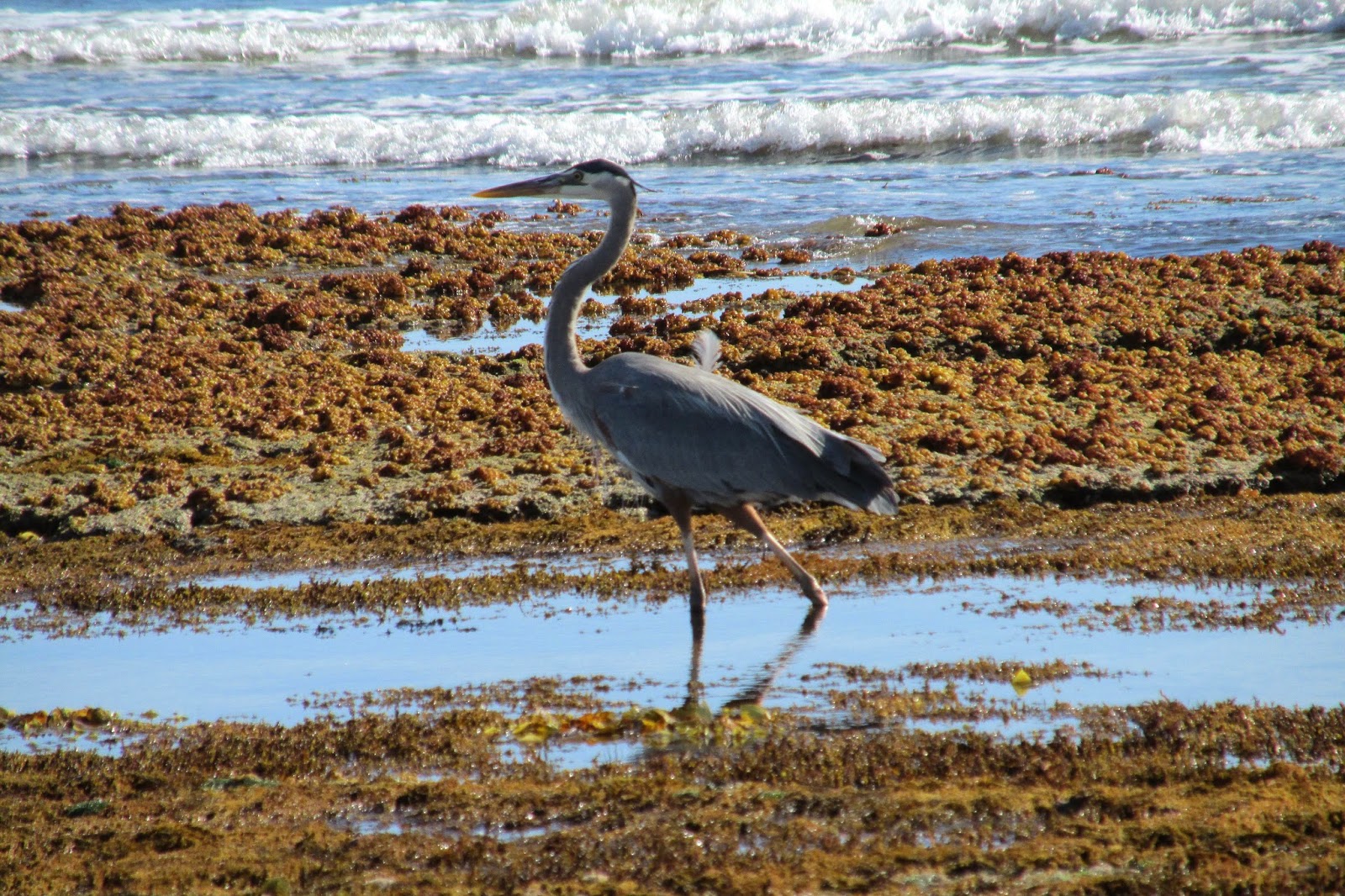
Who is easier to photograph than a great blue heron, his statue-like stance lasting for minutes on end. Even when disturbed, his takeoff is slow and deliberate.


Or the lovely egrets, snowy and great, so elegant in their long, white attire.  


As he strolls along, the snowy shakes his foot around in the water, stirring up any little critter that might be trying to elude those sharp eyes and sharper beak.

In the early morning light I watched a flock of birds circle in unison and then land on the reef.  Closer inspection in the binoculars revealed the delicate and beautiful American avocets, joined by a friendly pelican.


As I got closer and the sun rose higher, the breeding colors became evident.That long, thin, upturned bill is used to sweep the shallow water for invertebrates, and to protect the nest against invaders.  Avocets will parasitize the nests of other shorebirds, and the avocet nests are often parasitized by other birds as well.


The tide moves quickly in this far end of the gulf, and within a few minutes the avocets perch was swamped, and off they went, long legs trailing behind, flashing their colors in the sun.


Among the tidepools were many small crabs, blending so skillfully into the crusty brown reef, or scurrying to hide in a crevice at the approach of a giant mammal.  This one cracked me up.  Instead of hiding, he raced out into the open and threw open his arms in a defensive posture, as if saying, bring it on, lady, I'm ready!


The rather plain-looking willet is common along all our shorelines, rather gray in non-breeding colors, and only slightly more colorful when breeding.  But when startled, they react with a piercing call, opening their wings and running or taking flight, flashing a distinctive white pattern on the wings.


Just prior to our arrival was a fascinating event, a grunion run.  These fish come up onto the sand in huge numbers, twisting themselves into the sand and laying their eggs.  The males frantically scurry around the eggs to fertilize them.  The incoming tide covers the eggs with sand, where they will hatch with the next full moon and high tide.  Meanwhile, however, the shorebirds go into a feeding frenzy, searching for the abundant delicacy.  Sandpipers, turnstones, plovers, willets and more, all intent on the buried treasure. Will there be any eggs left to hatch?  Surely, with the beach covered with fish and each female laying several thousand eggs, there will be plenty to make their way back to the sea.

Oh, that's not all, of course.  There were magnificent frigatebirds, ospreys hunting and nesting, gulls too many to name, terns hovering and diving, cormorants by the hundreds, tiny peeps, whimbrels, plovers and grebes.  It was all too brief.  But I got my saltwater fix.  And my shorebird fix.

Here's hoping all your getaways feed your passions.


Thursday, June 20, 2013

Breeze in the Pines

How lucky we are in Tucson to be able to drive 30 miles up into the Sky Islands, leaving the 100°+ temps behind and spend the day in the cool mountain breezes.  In the Sonoran Desert region, forest-clad mountain ranges with cool, moist habitats are separated and isolated from one another by 'seas' of arid, hot desert, and can be compared with islands in the ocean, thus the term Sky Islands.  An incredible diversity of plant and animal life exists  on these mountain slopes.  According to A Natural History of the Sonoran Desert, (Steven J. Phillips & Patricia Wentworth Comus, eds., Arizona-Sonora Desert Museum Press, 2000),
In fact, the "sky islands" of southeastern Arizona and adjacent Sonora are now recognized by the International Union for the Conservation of Nature as one of the great centers of plant diversity north of the tropics.


Looking from Mt. Lemmon to Tucson in the valley below, with the Santa Rita Mountains in the distance.
The first thing you notice upon arriving at the trailhead of the Aspen and Marshall Gulch trails is the sound of the breeze blowing through the pines.  And, of course, the almost-chilly mountain air.  My friend Marilyn and I set out on the Aspen Trail with no agenda except to have no agenda.  Yes, we look and listen for birds, but also examine plants, exclaim over fascinating insects, take in the forest scents, thrill to the clouds of butterflies, take too many photos (me), discuss flower identification and marvel at the sheer beauty of our surroundings. 

Especially plentiful were Nais Metalmark butterflies on Fendler's ceanothus.  The tiny white flowers were also attractive to a collection of other insects including flies, bees, wasps and other butterflies. 


Tiny blue butterflies of several species delighted us at every turn.  The shocking blue upper wings of the echo azure made their identification easy.  Yellow-eyed juncos were the most common bird species, often hopping along on the ground, a mom feeding a juvenile.  We were excited to get excellent views of the red-faced warbler who sat still just long enough for me to think about getting a photo.  A beautiful red dragonfly (flame skimmer?) sat patiently for his portrait.
 
 
And just when I was losing hope of seeing one, a small horned lizard scrambled across the path and then froze, waiting for the giant mammals to pass. His camouflage was so perfect that if he hadn't moved, he never would have been spotted. We weren't about to pass, however, without some photos.  This is the greater short-horned lizard, a higher elevation horned lizard who primarily feeds on ants, but will also take beetles, grasshoppers and other insects. 
 
As we sat on a log having a snack, a fresh and beautiful Arizona sister butterfly fluttered by, sitting only briefly.  Stands of bright red bearded penstemon bloomed alongside the path, bird songs competed with one another high up in the trees, and strange little bugs went about their business.  How would you like to be known as the fungus-pleasing beetle?  Well, this guy is, and the fungus seemed mighty pleased!
 
 
Taking the return trail through Marshall Gulch we descended into a cool, moist, leafy microhabitat where deciduous trees such as big-tooth maple dominate, and the creek remnant pools are lined with red and yellow monkeyflower and golden columbine. 


A beautiful two-tailed swallowtail butterfly patrolled along the creek, and congregating on rocks in the pools were groups of blue butterflies.


Too soon we had reached the parking lot, which was now full, and it was time to sit at the picnic tables having a little lunch while going over our lists and through our field guides. 


Here is our bird list for the day:
Yellow-eyed Junco
Turkey Vulture
Broad-tailed Hummingbird
Acorn Woodpecker
Cordilleran Flycatcher
Common Raven
Mountain Chickadee
White-breasted nuthatch
red-breasted nuthatch
Pygmy Nuthatch
House Wren
Hermit Thrush
American Robin
Black-headed Grosbeak
Spotted Towhee
Black-tailed Gnatcatcher
Stellar's Jay
Red-faced Warbler


May your summer bring you cool mountain breezes through the pines.  Happy Summer Solstice!