Phainopepla

Phainopepla
Phainopepla
Showing posts with label Sea of Cortez. Show all posts

Sunday, March 30, 2014

Gulf Getaway


It was just a quick trip down to "Tucson's Beach" - Puerto Peñasco, at the head of the Gulf of California, aka the Sea of Cortez.  Rapid development is taking over the once-lonely beaches, with a big cruise ship port now being constructed on the beach where we stay.  But for now, it's still pretty peaceful. The huge tidal swing creates wonderful tidal flats which attract a great array of seabirds, feasting on the small fish and crustacean population.


After diving time after time for fish, drying one's wings is in order.  The large population of brown pelicans stays well-fed in these shallow waters.  Several pairs of American oystercatchers hunt along the reef, squawking in complaint and flying off when any human approaches. Don't you just love their colors?

They use that big, bright beak to pry open oysters and other bivalves.  The American oystercatcher is a permanent resident around the Sea of Cortez and south.  They roost on beaches, dunes or march islands, rarely venturing inland.  Nests are simple scrapes on the beach lined with shells.  They might make 5 or more nests before choosing one.

The other striking beauty along the beach is the black-necked stilt (Himantopus mexicanus), with long reddish legs, and sharply patterned black and white body.


Black-necked Stilts wade in shallow waters to capture their meals of aquatic invertebrates and fish. They often consume such fare as crawfish, brine flies, brine shrimp, beetles, water boatmen, and tadpoles. They peck, snatch, and plunge their heads into the water in pursuit of their food, and will herd fish into shallow waters to trap them there.

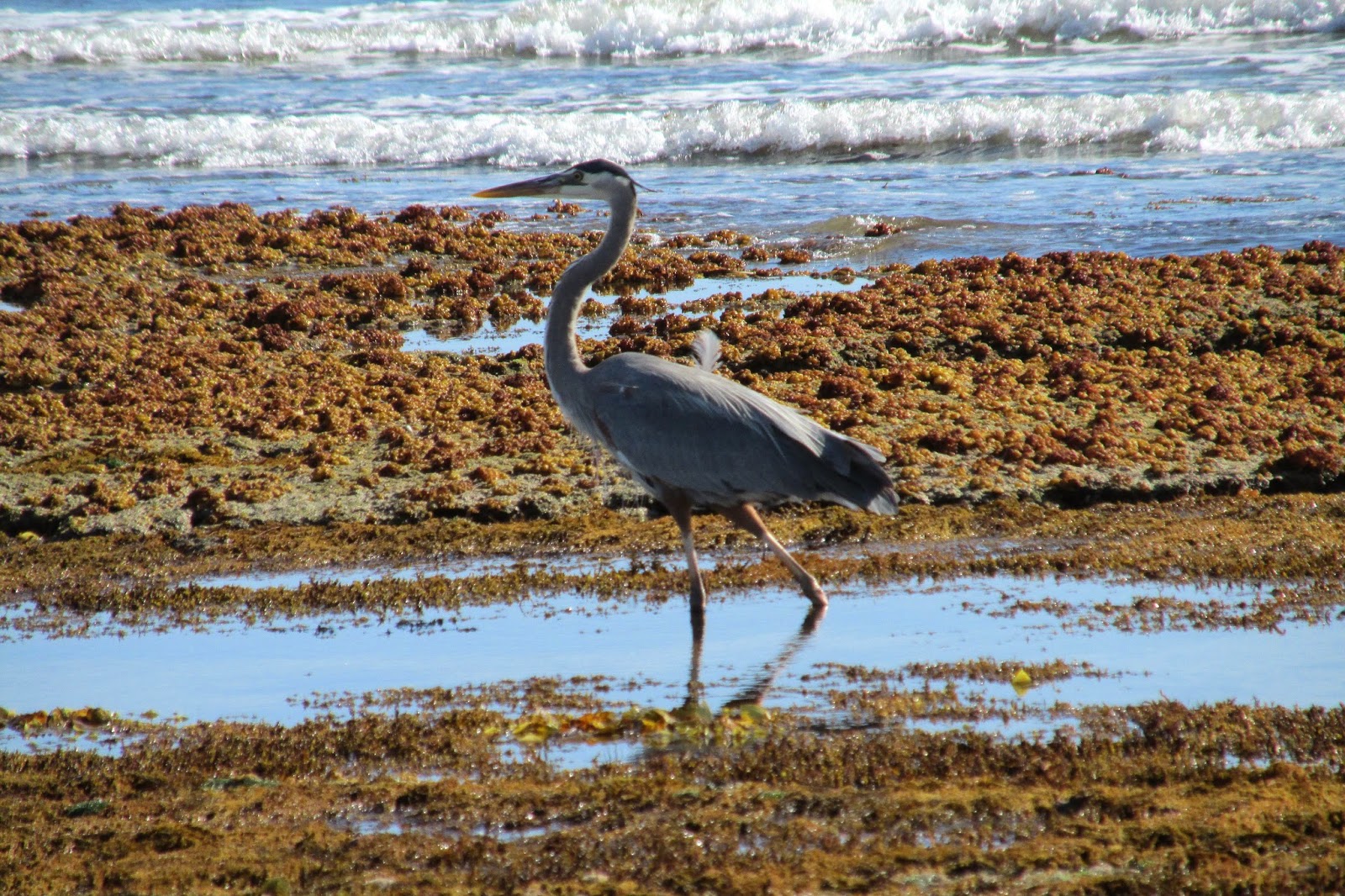
Who is easier to photograph than a great blue heron, his statue-like stance lasting for minutes on end. Even when disturbed, his takeoff is slow and deliberate.


Or the lovely egrets, snowy and great, so elegant in their long, white attire.  


As he strolls along, the snowy shakes his foot around in the water, stirring up any little critter that might be trying to elude those sharp eyes and sharper beak.

In the early morning light I watched a flock of birds circle in unison and then land on the reef.  Closer inspection in the binoculars revealed the delicate and beautiful American avocets, joined by a friendly pelican.


As I got closer and the sun rose higher, the breeding colors became evident.That long, thin, upturned bill is used to sweep the shallow water for invertebrates, and to protect the nest against invaders.  Avocets will parasitize the nests of other shorebirds, and the avocet nests are often parasitized by other birds as well.


The tide moves quickly in this far end of the gulf, and within a few minutes the avocets perch was swamped, and off they went, long legs trailing behind, flashing their colors in the sun.


Among the tidepools were many small crabs, blending so skillfully into the crusty brown reef, or scurrying to hide in a crevice at the approach of a giant mammal.  This one cracked me up.  Instead of hiding, he raced out into the open and threw open his arms in a defensive posture, as if saying, bring it on, lady, I'm ready!


The rather plain-looking willet is common along all our shorelines, rather gray in non-breeding colors, and only slightly more colorful when breeding.  But when startled, they react with a piercing call, opening their wings and running or taking flight, flashing a distinctive white pattern on the wings.


Just prior to our arrival was a fascinating event, a grunion run.  These fish come up onto the sand in huge numbers, twisting themselves into the sand and laying their eggs.  The males frantically scurry around the eggs to fertilize them.  The incoming tide covers the eggs with sand, where they will hatch with the next full moon and high tide.  Meanwhile, however, the shorebirds go into a feeding frenzy, searching for the abundant delicacy.  Sandpipers, turnstones, plovers, willets and more, all intent on the buried treasure. Will there be any eggs left to hatch?  Surely, with the beach covered with fish and each female laying several thousand eggs, there will be plenty to make their way back to the sea.

Oh, that's not all, of course.  There were magnificent frigatebirds, ospreys hunting and nesting, gulls too many to name, terns hovering and diving, cormorants by the hundreds, tiny peeps, whimbrels, plovers and grebes.  It was all too brief.  But I got my saltwater fix.  And my shorebird fix.

Here's hoping all your getaways feed your passions.


Tuesday, November 29, 2011

On the Wing in San Carlos

So diverse is the Sonoran Desert that it is divided into 6 subdivisions, only 2 of which are in the U.S.  The other 4 are all in Mexico, on the Baja Peninsula and the state of Sonora.  And another wonderfully unique feature of this desert is the inclusion of the Sea of Cortez, also known as the Gulf of California.

San Carlos, and its much larger neighbor, Guaymas, sit at the very southern edge of the Sonoran Desert, in the Central Gulf Coast subdivision, hugging the narrow sea.  I'm of the opinion that anytime you get the chance to be at the ocean, you must take it.   So, that's what we did, again taking advantage of the generous offer of our friends' condo on San Francisco Bay in San Carlos, hauling a turkey bird and all the Thanksgiving paraphernalia, for a lovely week at the beach.


The desert vegetation in this region is fascinating, and perhaps the subject of a future post, but for today, it's all about the birds.  Water, of course, is the magnet for so many species, bringing as it does a plentiful source of food.  But, where the desert meets the sea, you also have the joy of seeing those birds who call the desert home.  The water in the bay was literally alive with tiny, silvery, sardine-like fish, on which the pelicans, herons, egrets, loons, and dolphins feasted from first light until darkness enveloped the bay.


I had as my birding companion my friend Michelle, a relative newbie to birding, who makes up in enthusiasm what she lacks in experience.  Her excitement at each new discovery made me realize just how lucky I am to be able to enjoy such marvelous sights, sounds and places.

At the eastern end of the bay the water enters a mangrove-lined estuary, Estero el Soldado, now being protected by the Municipality of Guaymas, which is also slowly developing visitor facilities, signs and trails.  Currently, the visitor center and all the land around it are fenced off and closed to the public.  On this trip, however, I did see more hopeful indications that progress is being made.  New signs are being erected and scientists were doing studies and placing markers.


In the mangroves, herons, ibises, terns and egrets roosted, and foraged in the shallows.  Most exciting was the discovery of tri-colored herons, roseate spoonbills, yellow- and black-crowned night herons and even a group of white pelicans.  I laughed at the silly antics of the reddish egret as he ran about, danced and jumped, apparently scaring the little fish into submission.


Royal terns cruised endlessly over the shallows of the bay, making their spectacular dives and never coming up empty.  Brown pelicans gathered in huge flocks and went into virtual feeding frenzies, rising from the water surface just a few feet before diving again and quickly swallowing before starting the process again.


American oystercatchers squawked loudly with every disturbance, ospreys soared high above the water, as did the menacing-looking magnificent frigatebird, egrets and willets lined the beach waiting for their prey, and tiny peeps scurried in the surf.


Away from the water, our most thrilling moment came with the discovery of a group of great kiskadees in the tropical trees of the condo complex, foraging for the berries and chasing one another from tree to tree, their distinctive call alerting the observer to their presence.


We watched loggerhead shrikes and ash-throated flycatchers sallying from conspicuous perches, listened to elusive gnatcatchers and sparrows, and got so excited when we spotted the brilliant red of a northern cardinal among the green of a wolfberry bush.  A pair of American kestrels made one appearance, and we spotted a falcon (peregrine, I believe) flying high with a group of black vultures.


My photos don't do these guys justice.  I don't have the camera for really good bird photos.  A choice, at this point, for the incredible convenience of a point-and-shoot over the quality of a DSLR.  But, it's times like this when I reconsider that choice.

Here is the (mostly) complete list.  I'm far from an expert birder and could have some of the gulls and terns wrong.  There were many birds that were just too far away to positively identify, mainly ducks.  I love the birds that flash neon signs telling who they are - like the roseate spoonbill.


Cassin’s kingbird
Reddish egret
Tricolored heron
Great blue heron
Black-crowned night heron
American oystercatcher
Brown pelican
Osprey
Common loon
Willet
Western grebe
Magnificent frigatebird
Double crested cormorant
Great egret
Snowy egret
White ibis
Turkey vulture
Red-tailed hawk
Crested caracara
American coot
Least sandpiper
Royal tern
Snowy plover
Least sandpiper
Common raven
Great kiskadee
Lesser goldfinch
Loggerhead shrike
Eared grebe
Say’s phoebe
Heermann’s gull
Least tern
Rufous hummingbird
Costa’s hummingbird
Gila woodpecker
Chihuahuan raven
Rufous-crowned sparrow
Yellow-rumped warbler
Brown headed cowbird
House sparrow
Roseate spoonbill
Long-billed curlew
Yellow-crowned night heron
Verdin
Northern mockingbird
White-winged dove
American white pelican
Lesser yellowlegs
Marbled godwit
Ash-throated flycatcher
Western gull
Northern cardinal
Blue-gray gnatcatcher
House wren
Black vulture
Peregrine falcon
Bufflehead
Common merganser
California gull
American kestrel
House finch
Common ground dove
Northern rough-winged swallow
Caspian tern
Snow goose
Grackle
Northern harrier
Rock wren
Redhead duck


I'll have the rest of the photos posted on Picasa soon and I'll post a link here.

May all your birding adventures bring a smile to your face and joy to your heart!