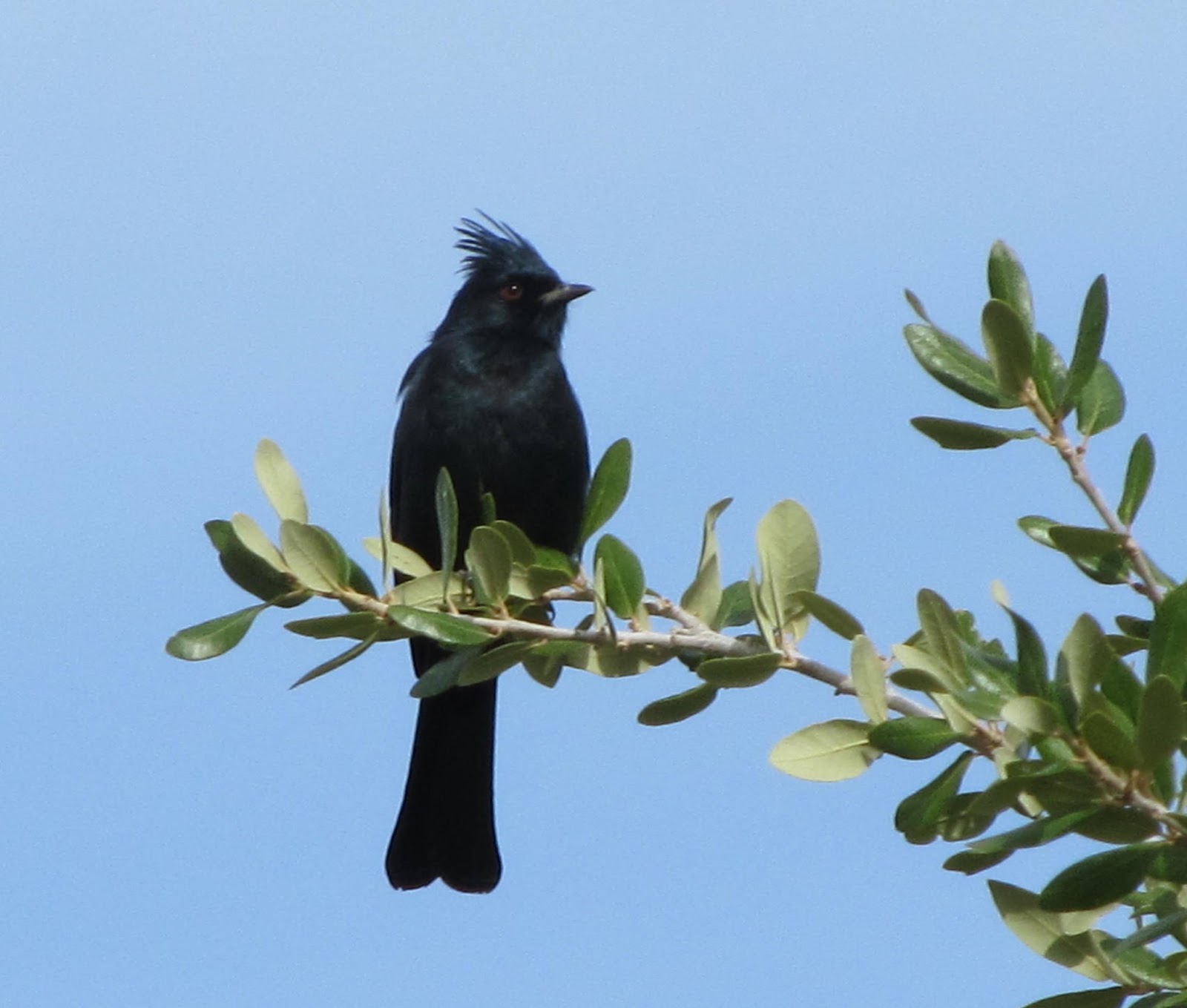
Phainopepla

Phainopepla
Phainopepla

Sunday, July 21, 2013

A Bloomy, Herpy, Birdy Day

The monsoon downpours have mostly avoided the Desert Museum, but the bit of rain that has been received has made a transformative difference.  The flowers have burst into bloom, the ocotillos are covered in green leaves, strange insects have emerged, and everything seems so ALIVE!

Fishhook Mammilaria with Bee

Grabbing my attention immediately were the tiny Mammilaria cacti (Mammilaria microcarpa) often hidden under vegetation which have now burst into bloom everywhere.  Delighting the eye like finding a hidden treasure.  A wreath of pink flowers encircles top of the stalks, which may only reach 6" in height.
Also called Pincushion Cactus
The somewhat nondescript Little Leaf Cordia shrub is also suddenly covered in blossoms - clusters of delicate white flowers that seem to float in the air.  Each afternoon the flowers fall off and the next morning the bush is covered with them once again.
Little Leaf Cordia (Cordia parvifolia)
Little Leaf Cordia Blossom
Hanging bunches of lemon-yellow trumpet-shaped flowers are brightening the Tecoma stans bushes, which both please and aggravate me - why can't MY Tecoma stans ever look this good?!

Yellow Trumpet Bush (Tecoma stans)
The normally-barren stalks of the ocotillo are now fully-leafed-out waving green wands.
Ocotillo in Leaf (Fouquieria splendens)
The leaves will remain until dry conditions return, eventually turning orange-brown and then falling off.  This cycle can be repeated many times during the warmer months.  The canes are covered with spines, but this plant is not a cactus.  With its relative the Boojum, it is a member of the Ocotillo family.

More yellow!  This is the Senna polyantha, whose large shrubs produce a mass of small, yellow, five-petaled flowers followed by bean pods containing the fruit.  As so many of our desert plants, this is a member of the Fabaceae family (lugumes).
Senna polyantha
Everywhere I went on the grounds, something was blooming.  I passed this attractive bouquet on my way to see what the Trichocereus garden was doing.

I wasn't disappointed.  Big, bright flowers greeted me as I came around the corner.


From the splashy to the more subtle, but no less beautiful.

Another docent had reported seeing Western tanagers in the Desert Garden earlier in the morning, so I thought I would try my luck at finding them.  I caught just a blur of red as one of the males flew by, but I hung around to watch a Northern Cardinal family.  I believe this is the juvenile getting a drink from the fountain.
And who's that in the background? Photobombed by a juvie brown-headed cowbird.  There are a lot of young birds everywhere at the Museum.  Just outside the Desert Garden in a pine tree was this Gila woodpecker family.  The parents working hard to feed the demanding youngster.
Gila Woodpecker Family (Melanerpes uropygialis)
I apologize for the quality of this photo.  The lighting was very difficult.  Very near here, in the fan palms, I saw a young male Hooded Oriole, one of so many species that nest here on the grounds.  Heading back around to the Pollination Garden, I was greeted by this mix of Mexican Bird of Paradise and Tecoma stans, framed by ocotillos.

The butterflies love the bird of paradise.  A pipevine swallowtail sat still just long enough for me to grab a quick photo.
Pipevine Swallowtail on Mexican Bird of Paradise
The lizards were out in force. I particularly like this zebra-tailed lizard who often carries his tail curled over his back, and waves it back and forth in the manner of a scorpion.
Zebra-tailed Lizard (Callisaurus draconoides)
It was about this time of day that I got a call on the radio that there was a Gila monster in the dry cave.  It's always a thrill to see a Gila monster in the wild, and I headed off across the grounds, getting stopped several times by visitors who had questions.  By the time I got to the cave, the docent there told me that the lizard had gone behind a large sign and was no longer visible.  By squeezing into a small space beside the sign and shining the light from the flashlight app on my phone, I was able to spot the fellow.  He had wedged himself as far as possible into a hiding space.

Although I felt bad about it, I had to call the herpetology folks to come and remove him.  The cave is quite dark and we didn't need the visitors stumbling into him if he went out roaming.  This is the only venomous lizard in the U.S., and while they are neither fast or aggressive, they can be dangerous if people get too curious.  (People do some really DUMB things!)  So, a few minutes later he was loaded in a crate, to be pit-tagged and then released off grounds.

Leaving the cave and making our way back to the docent office for lunch, a crowd had gathered to watch one of the botanists try to capture a coachwhip snake who had moved into the lizard enclosure.  To avoid the big human, the snake had climbed high into the large ironwood tree that is the centerpiece of the enclosure.
Coachwhip in Desert Ironwood
Can you see him up there?  These snakes are very fast! I never would have believed that the botany guy would be able to catch up to and grab the snake, especially without getting bitten.  Although they are not venomous, the word on coachwhips is that they are very bitey.  But I would have been wrong!  Down came Eric, snake in hand, having survived his encounter with that very prickly tree and with the snake.

Generally, the policy is to let non-venomous snakes alone unless they are in a place where they would threaten our exhibit animals (the lizards in this case).

In the afternoon, we got some more cheap entertainment watching the black-tailed prairie dogs and their ever amusing antics.

And, if that weren't enough fun for one day, there was one more snake on the schedule.  Some visitors spotted a snake sticking its head up out of a tree bowl in front of the hummingbird aviary.  Some fellow docents and I were just a few feet away so we got a lot of laughs watching the snake, another coachwhip, play hide and seek among the rocks and holes.  It reminded us of a game of whack-a-mole.  He would pop up one place, disappear, pop up a few feet away, then we'd just see a portion of the body slither by.  After ten minutes or so of this, out jumped a very tiny mouse and raced across the patio and up onto the roof of the aviary.  The snake looked out as in bewilderment.
Coachwhip looking for the Mouse

Eventually he emerged and crossed the patio looking for the darned mouse.
Mouse 1, Snake 0.

And with that, the day came to a close.  Back at home, a glass of wine in hand, I got another gift.  A magnificent sunset.
Sunset on Agave Drive
May all your days be filled with laughs and may they all have beautiful endings!

Sunday, July 14, 2013

A Color Burst

It was a lazy Saturday morning and I was in sloth mode.  I hadn't even taken my usual walk around the 3-mile neighborhood loop.  If you've ever seen the sloths of Central America, you know that their favorite 'activity' is just hanging out, usually sleeping.  To quote National Geographic, "The sloth is the world's slowest mammal, so sedentary that algae grows on its furry coat."  Rather than in a tree, I had perched myself in a comfy chair on the patio to enjoy the glorious, but all-too-brief show of the trichocereus cactus blooms in the garden.  Big puffy clouds kept the sun at bay and the temperature in the quite pleasant range. 

 
Trichocereus, also known as hybrid torch cacti, are popular with gardeners in Tucson for their huge, brilliant blooms.  Hybridized from tropical species, they are fairly cold tolerant, asking only for a bit of filtered shade and an occasional splash of water.  I have a collection of perhaps twenty plants in my Jardín Cactita, the little cactus garden.  A paltry number compared to the Desert Museum's large collection.


Cactus bees come to gather the abundant pollen and nectar, and pollinated plants will produce large, round fruits filled with tiny seeds. Being hybrids, it's doubtful that the seeds are viable, but I should ask a knowledgeable grower about this.  I might try growing some new plants from seed.
 
 
 For the most part, the blossoms only last one day, closing up by late afternoon, never to open again.  A couple of the species, however, produce flowers that will open for a second day.  Thus, it's important to take advantage of the event, drop what you had planned and simply enjoy!


Flower anatomy is primarily what determines the taxonomy of plants.  While it might seem obvious from looking at a plant that it is a cactus, that's not necessarily so.  Many non-cactus plants, for example, have spiny, sharp projections.  People often mistake some euphorbias, agaves and ocotillos for cactus.  Cactus flowers have a multi-lobed stigma (the white, or cream, structure in the center of the photos, the female part) and many stamens (the male, pollen-carrying structures deeper in the center). 

So, I was sipping my coffee, taking photos, enjoying the flowers and watching the hummingbirds zip around.  My year-around hummers are Costa's and Anna's and I am so accustomed to the sounds they make. 
 
 
So, when a new sound entered my consciousness, I looked quickly around to see one of the Anna's being chased by .  .  . a rufous??  Wow, what a surprise!  There was no doubt - the lovely rust-colored wings, the orange-red iridescent throat, and that famous rufous aggressiveness.  Even with my camera in my hand, I was too dumbstruck to take a photo.  Not that he would have slowed down long enough anyway.  The birding experts say the male rufous migrate early, but THIS early?  Oh, that was exciting.  The rufous made a couple more speedy passes by the feeder but never stopped to drink.
 
No sooner had I calmed down than another hummingbird flew right by my face and it was a blur of color that only registered as blue.  Blue?  Sure enough, a few moments later a better view revealed the red beak and the brilliant colors of a male broad-billed.  What a crazy day!  Flying flowers competing with the torches. 
 
A desert spiny lizard came out and posed with the flowers. 


Some Gambel's quail stopped by the snack bar.
 
 
And those flowers just kept on blooming.


Maybe every day should be a sloth day!  I won't get nervous until I start to see the algae grow.

Thursday, June 20, 2013

Breeze in the Pines

How lucky we are in Tucson to be able to drive 30 miles up into the Sky Islands, leaving the 100°+ temps behind and spend the day in the cool mountain breezes.  In the Sonoran Desert region, forest-clad mountain ranges with cool, moist habitats are separated and isolated from one another by 'seas' of arid, hot desert, and can be compared with islands in the ocean, thus the term Sky Islands.  An incredible diversity of plant and animal life exists  on these mountain slopes.  According to A Natural History of the Sonoran Desert, (Steven J. Phillips & Patricia Wentworth Comus, eds., Arizona-Sonora Desert Museum Press, 2000),
In fact, the "sky islands" of southeastern Arizona and adjacent Sonora are now recognized by the International Union for the Conservation of Nature as one of the great centers of plant diversity north of the tropics.


Looking from Mt. Lemmon to Tucson in the valley below, with the Santa Rita Mountains in the distance.
The first thing you notice upon arriving at the trailhead of the Aspen and Marshall Gulch trails is the sound of the breeze blowing through the pines.  And, of course, the almost-chilly mountain air.  My friend Marilyn and I set out on the Aspen Trail with no agenda except to have no agenda.  Yes, we look and listen for birds, but also examine plants, exclaim over fascinating insects, take in the forest scents, thrill to the clouds of butterflies, take too many photos (me), discuss flower identification and marvel at the sheer beauty of our surroundings. 

Especially plentiful were Nais Metalmark butterflies on Fendler's ceanothus.  The tiny white flowers were also attractive to a collection of other insects including flies, bees, wasps and other butterflies. 


Tiny blue butterflies of several species delighted us at every turn.  The shocking blue upper wings of the echo azure made their identification easy.  Yellow-eyed juncos were the most common bird species, often hopping along on the ground, a mom feeding a juvenile.  We were excited to get excellent views of the red-faced warbler who sat still just long enough for me to think about getting a photo.  A beautiful red dragonfly (flame skimmer?) sat patiently for his portrait.
 
 
And just when I was losing hope of seeing one, a small horned lizard scrambled across the path and then froze, waiting for the giant mammals to pass. His camouflage was so perfect that if he hadn't moved, he never would have been spotted. We weren't about to pass, however, without some photos.  This is the greater short-horned lizard, a higher elevation horned lizard who primarily feeds on ants, but will also take beetles, grasshoppers and other insects. 
 
As we sat on a log having a snack, a fresh and beautiful Arizona sister butterfly fluttered by, sitting only briefly.  Stands of bright red bearded penstemon bloomed alongside the path, bird songs competed with one another high up in the trees, and strange little bugs went about their business.  How would you like to be known as the fungus-pleasing beetle?  Well, this guy is, and the fungus seemed mighty pleased!
 
 
Taking the return trail through Marshall Gulch we descended into a cool, moist, leafy microhabitat where deciduous trees such as big-tooth maple dominate, and the creek remnant pools are lined with red and yellow monkeyflower and golden columbine. 


A beautiful two-tailed swallowtail butterfly patrolled along the creek, and congregating on rocks in the pools were groups of blue butterflies.


Too soon we had reached the parking lot, which was now full, and it was time to sit at the picnic tables having a little lunch while going over our lists and through our field guides. 


Here is our bird list for the day:
Yellow-eyed Junco
Turkey Vulture
Broad-tailed Hummingbird
Acorn Woodpecker
Cordilleran Flycatcher
Common Raven
Mountain Chickadee
White-breasted nuthatch
red-breasted nuthatch
Pygmy Nuthatch
House Wren
Hermit Thrush
American Robin
Black-headed Grosbeak
Spotted Towhee
Black-tailed Gnatcatcher
Stellar's Jay
Red-faced Warbler


May your summer bring you cool mountain breezes through the pines.  Happy Summer Solstice!


Wednesday, June 12, 2013

The Yard Birds

Weren't they a rock group in the 60's?  Part of the British Invasion, I seem to remember.  The current version of the Yard Birds may not be as loud, but they sure are a lot prettier!  Happily for us, many species of birds have adapted to human habitation, and provide us with the daily pleasure of their company right in our own back yards. 

Here, then, are the birds who visit me on a regular, or not so regular basis.  I'm not a purist, so if I see them in or from the yard, they count!


Every Day
 
Verdin
Cactus Wren
House Finch
House Sparrow
Mourning Dove
White-winged Dove (summer)
Gambel's Quail
Cooper's Hawk
Anna's Hummingbird
Costa's Hummingbird
Gila Woodpecker
Lesser Nighthawk (summer)
Lesser Goldfinch
Brown-Crested Flycatcher (summer)


Often, but not Every Day
 
Northern Cardinal
Pyrrhuloxia
Phainopepla
Red-tailed Hawk
Harris' Hawk
Common Raven
Curve-billed Thrasher
Western Screech Owl
Black-tailed Gnatcatcher
Turkey Vulture
Ladder-backed Woodpecker
Northern Mockingbird


Occasionally
 
Roadrunner
Peregrine Falcon
Prairie Falcon
Sharp-shinned Hawk
American Kestrel
Great Horned Owl
Zone-Tailed Hawk
Lucy's Warbler
Rufous Hummingbird
White-Crowned Sparrow
Abert's Towhee
Purple Martin
Ash-Throated Flycatcher


Seen, But Rarely
 
Black Phoebe
Western Bluebird
American Robin
Yellow Warbler
Violet-Crowned Hummingbird
Broad-billed Hummingbird
Rufous Hummingbird
Yellow-Rumped Warbler
Western Tanager
European Starling
Hooded Oriole
Black-Headed Grosbeak
Spotted Towhee
Yellow-Breasted Chat
Wilson's Warbler
Northern Rough-Winged Swallow
Great Blue Heron
Great Egret
Bewick's Wren
Inca Dove


I'm sure there are some I've forgotten.  I'm not always great about writing them down. 

Here's wishing you Happy Birding, even if it's just in your own back yard!


Wednesday, June 5, 2013

Barberry

This week I'd like to introduce you to another plant of the Sonoran Desert.  You may be familiar with this family as it is widespread and contains many species.


Berberis wilcoxii

Berberis haematocarpa


So many times when I have taken visitors on a tour of the Desert Museum grounds, I get asked about that "holly-looking plant".  Visitors invariably notice these interesting plants and ask the docent about them as it reminds them of a familiar plant from home.  Both species above, along with another one you’ll be surprised about, are barberry species, in the genus Berberis and the family Berberidaceae, and are planted in our Mountain Woodland.  The third species is B. longipes, a Sierra Madre plant that grows in tree, rather than bush, form.  The B. wilcoxii and B. longipes are located behind the benches facing the bear enclosure, while the B. haematocarpa is along both sides of the path near the wolf enclosure.  Two more species, B. fremontii and B. trifoliate are included the Desert Museum’s collection.  Look for B. fremontii in the Bee Garden, and B. trifoliate in the Desert Garden.

Berberis is a very large genus of perhaps 500 species worldwide, many of which are widely planted as landscape specimens, and some imported species of which have become invasive.  Barberries are closely related to the genus Mahonia, and some references use the names interchangeably.

The genus Berberis has many antibacterial, antitumor and tonic medicinal uses.  Berberine, universally present in rhizomes of Berberis and Mahonia species, has marked antibacterial effects and is used as a bitter tonic.  Since it is not appreciably absorbed by the body, it is used orally in the treatment of various enteric infections, especially bacterial dysentery.  For highest concentrations, the root and root bark are best harvested in the autumn.


The primary bioactive constituent of the species in the Berberidaceae family is the yellow alkaloid berberine.  It is found in the foliage, stems and roots, although usually strongest in the roots. The roots and lower yellow stems are gathered from midsummer to winter, the leaves from May through mid-fall. The cleaned roots are chopped while still fresh since they become very dense and hard once dry. If there is a layer of brown bark on the stems and roots, this is scraped off and only the yellow parts are used. The leaves can be collected and dried in a paper bag. The dried leaves, stored away from any light, will last for up to a year. The dried roots and stems will last for several years.


 In the Southwest, curanderas boil the leaves in water and drink the tea twice a day for anemia, and take the decoction early in the morning before eating to bring on menstruation. The leaves or roots are boiled or tinctured and taken internally to cleanse the blood. The Navajos use a decoction of the leaves and stems to relieve the inflammation of rheumatism. The tea from the roots has been used as an alterative, antisyphilitic, diuretic and laxative. Of the species with juicy berries, the ripe berries can be made into a tasty jam that some call happy berry jam because it tends to lighten depressed moods.

Plants in the family Berberidaceae all have high concentrations of xanthophyll (yellow) pigmentation in the stem. A yellow dye is obtained from the inner bark of the stem and roots. An ink is made from the wood. Dark green, violet and dark blue-purple dyes are obtained from the fruit. A green dye is obtained from the leaves

Six species of Berberis have been identified in Arizona.  The most common of these is B. haematocarpa, known also as red barberry for the red, juicy berries it produces.  It can be found growing in desert grasslands and oak woodlands, from 3000’ to 5000’ in elevation.  On our recent visit to Arivaca Cienaga, many large red barberry plants were blooming along the paths.  Growing to about 12’ tall and 12’ wide, the dense evergreen shrub makes a good wildlife cover.  The fragrant flowers have 6 yellow petals and stamens and grow in a loose cluster.  The fruits can be used to make red jelly, and are relished by birds, while the root and bark are useful for making a yellow dye.  Leaves are pinnately compound with 3-5 leaflets which are lobed, each of the lobes ending in a sharp spine. 

B. trifoliate, also called trifoliate barberry, has narrow leaves with 3 leaflets, each of which is deeply lobed.  Flowers are also very fragrant and the fruit edible.  B. fremontii grows at higher elevations, typically 4-7000', in pinon-juniper and pine woodlands, and blooms from April to July.  The Hopis use the wood for crafts and the roots for yellow dye. 


The Desert Museum has an incredible collection of plant species, and it seems that every time I’m on the grounds I notice something I hadn’t seen before.  It’s a constant learning experience. 


Epple, Anne Orth; A Field Guide to the Plants of Arizona; The Globe Pequot Press, 1995, pp.72-74
Montgomery, George; Curator of Botany, Arizona Sonora Desert Museum; personal correspondence
Journal of the Arizona-Nevada Academy of Science, Vol. 26 (1), 1992, pp. 2-4