Phainopepla

Phainopepla
Phainopepla

Thursday, May 1, 2014

Blowing Into May

Hummer hovering over flowering saguaro

Springtime in the desert often brings gusty winds caused by pressure ridging across the southwest.  Today is especially nasty with the strong winds bringing dust so intense that we cannot see the mountains only a mile away.  So, it must be a day to work on the blog.

The end of April was crazy busy with preparations and company in town for my niece's wedding.  So there were bridal teas, dinners, brunches, garden tours and more.  Although my niece, Amy, and her new husband live in Tucson, everyone else was from out of town, including all of my family. My house thus became the base of operations. It was wonderful to see them all, but stressful too.  Especially having 13 people at the bridal tea sitting at my dining table, with room for half that many.  On the weekend, the weather looked to be questionable, but turned out perfect on the day of the ceremony.


In the garden, the torch flowers have begun to bloom, the prickly pear continue their flowering and the yellow of the palo verde flowers enliven the landscape.


Nesting and migrating birds fill the yard and the neighborhood.  Up the street, the Harris' hawks have chicks in the nest high up in a big eucalyptus.  Harris' hawks are a social species, living year around in family groups.  All the members participate in the nesting process by guarding the nest and helping to feed the chicks.


By my front door, an Anna's hummingbird chose this location for her nest.  Apparently she didn't really think it through, as all the traffic in and out of our front door caused her to soon abandon the nest without laying eggs.

Tiny Gambel's quail chicks scurry after mom and dad very soon after hatching. Precocial is the term for ground-nesting birds who are ready to travel almost immediately, with feathers and eyes open.   I don't think this brood was hatched in the yard, but it might have been.  Often, there are up to 13 or 15 chicks in a brood, but with a high rate of mortality, perhaps 2 or 3 will survive to adulthood.


The saguaro cactus are now in full bloom, the sweet flowers attracting pollinators such as cactus bees and white-winged doves.  It was a first for me to see this hummingbird feeding repeatedly from a saguaro flower.


Migrators are making their way to their summer homes, stopping for a rest in my yard.  Right now I have several black-headed grosbeaks hanging around the nut feeder before heading for higher elevation.  In this shot, there is a male on the left and a female on the right.


I've also had broad-tailed and broad-billed hummers stop by for sustenance, but they are much too quick for my camera to capture.

Between all the wedding events, my sister and I found time to do a little hike to some ancient petroglyphs, and then to the adjoining Saguaro National Park.


The rain clouds were gathering and the temperature dropping when  we made it back to the parking area just as the first drops were falling.  The light was not good to capture the lovely color of the blooming ironwood trees.


The rainstorm that ensued was all too brief to quench the parched desert, but we welcome every drop.  Soon our beautiful spring will feel like summer and the rain will be a distant memory sustaining us until the summer monsoon arrives.

Here's hoping all your spring days are filled with color and beauty!

Saturday, April 19, 2014

Prickly Pear

Prickly Pear
Opuntia sp.


The cactus are bursting into bloom, at the Desert Museum we're doing Wildflower Walks and Cactus Tours, so what better time to think about the Prickly Pears. In the family Cactaceae and the genus Opuntia, prickly pears are native only to the Americas, but are now seen growing around the world, and are even considered invasive pests in many places.   It's easy to get confused about what cactus are included in this genus as taxonomy is ever-changing.  Chollas were traditionally included with prickly pear in the Opuntia genus, but have now been separated into their own genus - Cylindropuntia.  Most sources now agree that now Opuntias only include the paddle cactus or, as we know them, prickly pears.  There are approximately 200-300 species included in the genus, only a small portion of which are native to  North America. 

Prickly pears are typically easy to recognize with their flat, rounded stems (also called cladodes) that are protected with two types of spines - large, smooth, fixed spines and tiny, hairlike, barbed prickles called glochids.  The latter easily detach from the plant and penetrate the skin, causing annoying itch and irritation.  Some species are considered spineless, including beavertail and Santa Rita, but all have glochids. 

Santa Rita pads showing glochids


The fleshy pads are actually modified branches or stems that serve several functions - water storage, photosynthesis and flower production.  The flower buds arise from aereoles, and the prickly pear flowers are easily recognizable as those of a cactus as they have many tepals that intergrade with each other; many stamens and a multilobed stigma.   Yellow is the primary color of our native prickly pear flowers.  On some species, the yellow flowers will turn a peachy color by the afternoon before closing.

The main pollinators of our prickly pears are cactus bees - several native bee species that specialize in cactus.  Cactus pollen is gathered and then packed into the bees' burrows to feed the grubs.  Once pollinated, the prickly pears produce elongated, swollen fruit that are juicy and sweet.  Large numbers of the fruit are produced in July and August, ripening to a deep red color.  They are enjoyed by a wide variety of animals including rabbits, packrats, javelina, deer, squirrels, desert tortoises, cactus beetles and many bird species, all of whom help propagate the plants by disbursing the seeds.  People, too, love the fruit!  Also called "tunas" the fruit are sold in many forms such as jelly, candies and lemonade.  The most popular source for tunas , as well as nopales (the young pads) is the Mexican species of prickly pear - Indian Fig (Opuntia ficus indica).  


Engelmann's Prickly Pear Fruit

In North America, prickly pear cactus are found in all the deserts of the Southwest, with different species having adapted to specific locales and elevation ranges.  Most can be found in course, well-drained soil in dry, rocky flats or slopes.  But some prefer mountain piñon/juniper forests and yet others require steep, rocky slopes in mountain foothills.  The little cochineal bug played a major role in the spread of prickly pear to other continents - a fascinating story that I'll save for another day.  Another player in the globalization of prickly pear was the desire of gardeners and plant fanciers to grow exotic species.  Australia, in particular, has suffered from the indiscriminate introduction of prickly pear from South America.  There it has become a terrible, invasive weed whose clonal spread has been difficult to control. 

In recent years there has been medicinal interest in the role that the pectin in prickly pear pulp can play in reducing levels of 'bad' cholesterol while not affecting 'good' cholesterol levels.  The fibrous pectin in the fruit may also lower diabetics' need for insulin.  Both fruit and pulp are rich in slowly absorbed soluble fibers that may help keep blood sugar stable. 

The color of the stems of our native prickly pears varies from the green of Engelmann's to the purple of Santa Rita.  The purple will be more intense in the cool, dry winter months, and a softer blue-gray in the summer once the rains arrive. 

Santa Rita Prickly Pear

Now is a great time to go exploring on the grounds for all the interesting varieties of prickly pear in the ASDM collection. 

And, thanks to the good suggestion by fellow blogger, Marilyn Kirkus, here is a link to an excellent article on harvesting and preparing prickly pear fruit and pads.  Enjoy!


Wednesday, April 9, 2014

Docent Diaries

No matter what my assignment, I love my docent duties at the Desert Museum.  Some jobs, however, are more fun than others.  For the past two years, my friend Mary Lou and I have been the Day Captains for the Friday Docents.  Which means we 'get' to spend most of our day in the office doing schedules, organizing the day, making coffee, entering data in the computer, being the in-charge people for all the docent activities for the day, cleaning up the office and lounge, and generally, as another friend put it, "herding cats".  (Just try getting them all together for a photo!) Managing people is always entertaining, frustrating, interesting and normally chaotic.  The reason we became docents, however, is to be out on the grounds of the Museum, talking to visitors and interpreting the Sonoran Desert.  Soon my captaincy stint will be over and I'll be back out doing the really fun stuff.

Here's what our group looks like this year.


There are four or five missing.  It's impossible to find a day when everyone is there, or makes it to the photo shoot on time.  But, this isn't bad.

 Mary Lou and I agreed that, no matter how busy we were, we would still take out our animals for one hour a day.  I am certified this year on Large Raptor, which means I can take out either a Harris' hawk or a barn owl.  We take them out in rotation, and on this day, it was a hawk.


Harris' hawks are a very unique raptor that we are privileged to have as permanent residents in Southern Arizona.  What sets them apart from most other birds of prey is that they are a social raptor, living together in family groups, hunting cooperatively, and all taking part in the nesting process.  The younger birds from the previous brood will assist the parents in guarding the nest and bringing food for the mother and the nestlings.  In each group, an alpha female will be dominant.  The bird I am holding is an adult male.  Males and females are colored alike, but what distinguishes them is size - the females are significantly larger.  For the past several years, I have had Harris' hawks nesting in my neighborhood, and I am now seeing the female on the nest once again.  Every day from October through April, the Museum flies a group of Harris' hawks in our Raptor Free Flight program.  It's a thrilling experience to have one of these big birds fly so closely over your head that their feathers so briefly and gently touch you.  Each year docent can choose which group of animals we want to interpret to the public.  We then go through training and certification to keep our skills current.  The Desert Museum is accredited by the AZA (Association of Zoos and Aquariums), which sets exacting standards for animal care and handling.

Mary Lou and I try to finish most of our duties by around 3pm, which gives us some time to go explore the grounds, talk to visitors, look for fun and interesting sights, and have a little 'play' time.  April is a good time to see butterflies, as well as their larvae and pupae.  Right now, the Pipevine Swallowtails are abundant in all forms.

These handsome guys are the larvae, feeding happily on pipevines,


Soon they will be forming a chrysalis and undergoing the amazing metamorphosis that will allow them to emerge in a totally new form.  Here's what the chrysalis looks like:

Pipevines have a strange little flower called the pipe.


Which is then followed by this fruit.

Sadly I do not have a suitable photo of the adult pipevine swallowtail butterfly, so please excuse me for borrowing a couple from one of my favorite sites, Firefly Forest

As she says, they are difficult to photograph as they seldom sit still.  I guess that's my excuse.  With their iridescent blue on the upper hind wings, and the array of colored spots on the lower wings, these large black butterflies are stunningly beautiful.

With our lack of rain and warm weather, everything seems to be happening a little earlier this year, like the cactus blooming.  All around the grounds, and out in the desert, little hedgehog cacti are sporting their gaudy pink finery, forcing me to stop and get yet another photograph.  Hedgehogs are a small, multi-trunked cactus, generally somewhat inconspicuous until bloom time.


Glorious too are the claret cups, which are another form of hedgehog cactus, and are one of the earliest to bloom.  They are just about finished now, but this one waited for me.


The Museum grounds are alive with dozens of species of blooming flowers, and it is inspiring to just stroll through the gardens and various habitats and take in the amazing palette.

Here are just a few more. Fairy Duster, yellow primrose, blackfoot daisy and California buckwheat.


Lastly, we stopped by to see the coatis, and watched a young Cooper's hawk watching us.


Ahhh, no wonder I long to spend the entire day out on the Museum grounds talking to visitors and just enjoying the theater. Soon, very soon, I'll be able to do that.  At my age, however, I do not wish to speed up time.  So I will enjoy every day as a docent at the Arizona Sonora Desert Museum, no matter what it brings.

May every day be one you treasure.

Sunday, March 30, 2014

Gulf Getaway


It was just a quick trip down to "Tucson's Beach" - Puerto Peñasco, at the head of the Gulf of California, aka the Sea of Cortez.  Rapid development is taking over the once-lonely beaches, with a big cruise ship port now being constructed on the beach where we stay.  But for now, it's still pretty peaceful. The huge tidal swing creates wonderful tidal flats which attract a great array of seabirds, feasting on the small fish and crustacean population.


After diving time after time for fish, drying one's wings is in order.  The large population of brown pelicans stays well-fed in these shallow waters.  Several pairs of American oystercatchers hunt along the reef, squawking in complaint and flying off when any human approaches. Don't you just love their colors?

They use that big, bright beak to pry open oysters and other bivalves.  The American oystercatcher is a permanent resident around the Sea of Cortez and south.  They roost on beaches, dunes or march islands, rarely venturing inland.  Nests are simple scrapes on the beach lined with shells.  They might make 5 or more nests before choosing one.

The other striking beauty along the beach is the black-necked stilt (Himantopus mexicanus), with long reddish legs, and sharply patterned black and white body.


Black-necked Stilts wade in shallow waters to capture their meals of aquatic invertebrates and fish. They often consume such fare as crawfish, brine flies, brine shrimp, beetles, water boatmen, and tadpoles. They peck, snatch, and plunge their heads into the water in pursuit of their food, and will herd fish into shallow waters to trap them there.

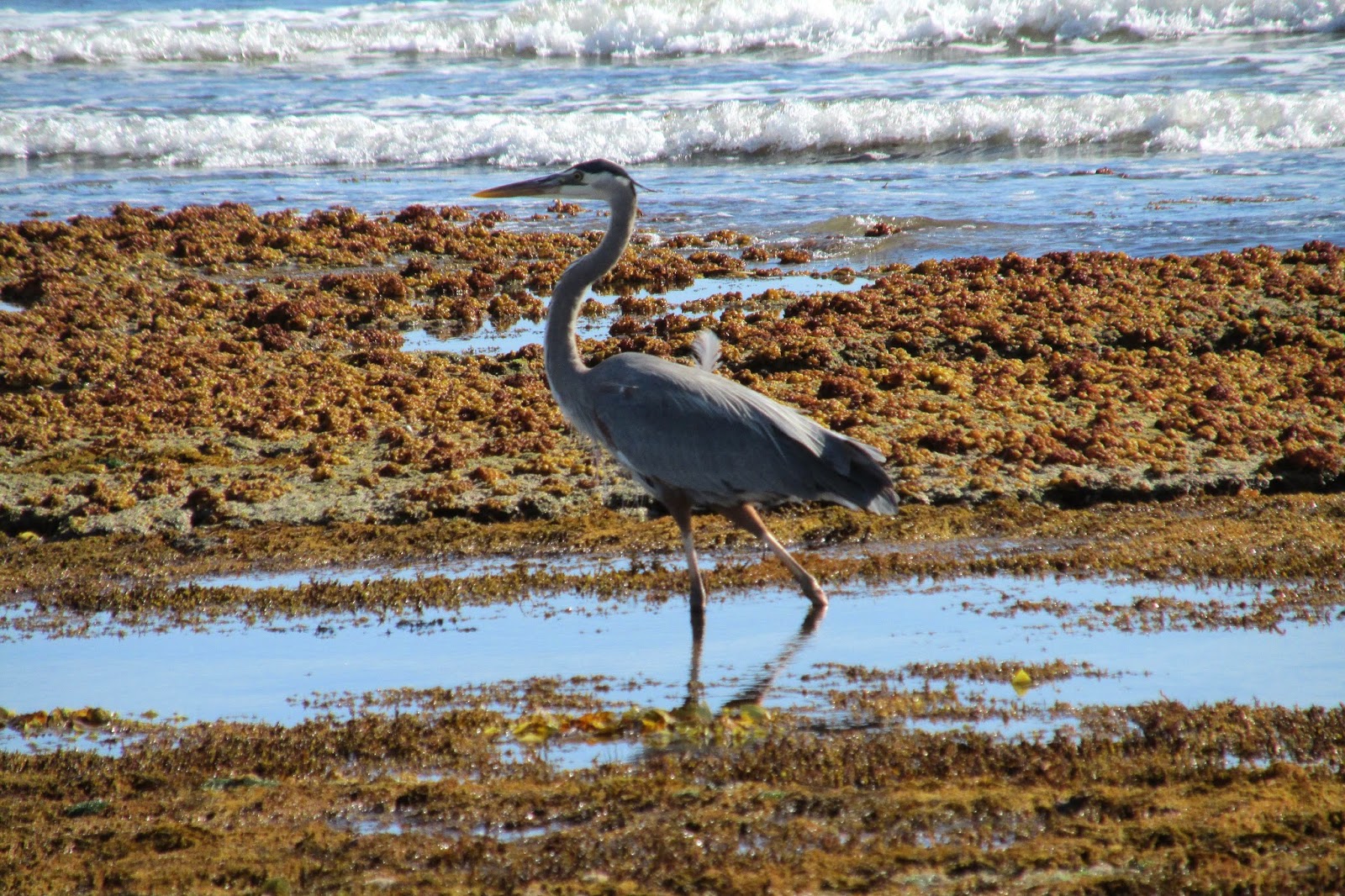
Who is easier to photograph than a great blue heron, his statue-like stance lasting for minutes on end. Even when disturbed, his takeoff is slow and deliberate.


Or the lovely egrets, snowy and great, so elegant in their long, white attire.  


As he strolls along, the snowy shakes his foot around in the water, stirring up any little critter that might be trying to elude those sharp eyes and sharper beak.

In the early morning light I watched a flock of birds circle in unison and then land on the reef.  Closer inspection in the binoculars revealed the delicate and beautiful American avocets, joined by a friendly pelican.


As I got closer and the sun rose higher, the breeding colors became evident.That long, thin, upturned bill is used to sweep the shallow water for invertebrates, and to protect the nest against invaders.  Avocets will parasitize the nests of other shorebirds, and the avocet nests are often parasitized by other birds as well.


The tide moves quickly in this far end of the gulf, and within a few minutes the avocets perch was swamped, and off they went, long legs trailing behind, flashing their colors in the sun.


Among the tidepools were many small crabs, blending so skillfully into the crusty brown reef, or scurrying to hide in a crevice at the approach of a giant mammal.  This one cracked me up.  Instead of hiding, he raced out into the open and threw open his arms in a defensive posture, as if saying, bring it on, lady, I'm ready!


The rather plain-looking willet is common along all our shorelines, rather gray in non-breeding colors, and only slightly more colorful when breeding.  But when startled, they react with a piercing call, opening their wings and running or taking flight, flashing a distinctive white pattern on the wings.


Just prior to our arrival was a fascinating event, a grunion run.  These fish come up onto the sand in huge numbers, twisting themselves into the sand and laying their eggs.  The males frantically scurry around the eggs to fertilize them.  The incoming tide covers the eggs with sand, where they will hatch with the next full moon and high tide.  Meanwhile, however, the shorebirds go into a feeding frenzy, searching for the abundant delicacy.  Sandpipers, turnstones, plovers, willets and more, all intent on the buried treasure. Will there be any eggs left to hatch?  Surely, with the beach covered with fish and each female laying several thousand eggs, there will be plenty to make their way back to the sea.

Oh, that's not all, of course.  There were magnificent frigatebirds, ospreys hunting and nesting, gulls too many to name, terns hovering and diving, cormorants by the hundreds, tiny peeps, whimbrels, plovers and grebes.  It was all too brief.  But I got my saltwater fix.  And my shorebird fix.

Here's hoping all your getaways feed your passions.