Phainopepla

Phainopepla
Phainopepla

Sunday, October 9, 2011

This Week in the Garden

Plant sales.  I am unable to resist them.  And this is plant sale season in Tucson.  So when the Desert Museum had their sale recently, of course I had to go.  The line of people already waiting to pay for their purchases almost made me give up before starting.  But, we had driven all the way out there, and there were some wonderful plant specimens, so we soldiered on.  Three cacti and one passionvine later we were in line, Jay and me and my fellow docent Mary Lou.  About that time one of the Botany folks came along to write up our purchases and advise us that there was a separate cash line.  I went off to investigate, leaving the others to hold down our place in line, just in case.  How nice to discover not one person in the cash 'line'!  We were out of there in no time.

These new cactus specimens, plus two others that my friend Marilyn had given me now necessitated expanding my Small Cactus Garden, (cactita?) an area under an expanding blue palo verde tree that provides them some important filtered shade so they can survive the Tucson summers.  Jay helped me lay it out, mix sand and soil, fill the designated area and line it with rocks.


The new additions include two Coryphantha elephantidens from Marilyn, two Trichocereus (trichocerei?) which  will hopefully be two different color blooms, and one Hecho cactus with two stems.  The Hecho may have been a mistake as it does not like cold, and if it does do well, it gets huge.  So, we'll see about that.  The Trichocereus (hybrid torch) produce the huge, glorious blooms that just take your breath away.  Joining these new friends in the garden are two small pots - one with a variegated agave and the other with another Coryphantha species that is about to bloom.  The agave really should be unpotted (is that a word?) and put in the ground where it can spread its roots and grow.

The poor passionvine still sits in its nursery pot, waiting for its new home, which, at this writing, is still under discussion.  I'd like to plant it in the front courtyard on the shady side, with a trellis that will show off it's glorious purple blossoms.  And, it's looking rather ragged at the moment as I discovered several gulf fritillary butterfly caterpillars munching happily away on foliage and flower.  And, not two days after bringing it home, an adult gulf fritillary came to visit the passionvine and, if I"m lucky, deposit her eggs.  After all, the attraction of these spectacular butterflies is one of the main reasons to own this species.


Another reason, of course, is the beautiful flower, which sometimes also gets eaten by the voracious larva.

One of the caterpillars evidently decided it was time to go and find a place to spin its chrysalis as it took off and made it's way along the garage wall.


The same day, this handsome fellow was spotted, also on the garage wall, but in a different vicinity. It seems that I see a walking stick here about once a year.  Where do they go the rest of the time?


Hard to see, huh?  No wonder I rarely see them.  My husband gets credit for spotting this one.

The golden barrel has decided to bloom again.  This is a species (Echinocactus grusonii) native to Mexico, but widely grown in landscape in the Southwest.


Here are a few other blooms from the garden.

And speaking of caterpillars, I was happy to find some giant swallowtail caterpillars on my sad old lemon tree leaves.  The poor, ancient tree was on its death bed, and then along came the big freeze of 2011 and that was the final death knell.  We cut the tree down, intending to replace it with something more native, but have yet to dig out the stump.  New leaves are emerging, just the place for a giant swallowtail to deposit her eggs.  


If you were a bird looking for a tasty morsel, you would most likely pass this caterpillar by, resembling as it does just some bird poop.  Pretty good camouflage idea.

Passing by a foothills palo verde tree in the yard, something caught my eye.  A little closer examination revealed the egg case of a praying mantis, a lovely little object that looks as though it were sewn together.

I'm not sure if these will hatch this fall or overwinter in this form.  I'll keep watching, and look forward to having some mantis nymphs.

Another small discovery, sitting on the flower of the yucca was this interesting little creature, a leaf-footed bug.

Now blooming in the desert is the amazing creosote bush (Larrea tridentata), the most drought tolerant perennial plant in our desert, and among the longest-living of all plants. The yellow flowers occur at various times, usually following a rain. The fruit is a small, fuzzy white ball. Many insects feed on creosote bush, but few mammals do, probably only the jackrabbit.


It was a Murphy's Law kind of day when I looked out the window and saw a small lake forming in the yard, water bubbling up out of the ground.  Repairing the drip irrigation is a constant, ongoing project.  We dug down to expose the pipes, about two feed under the pathway.
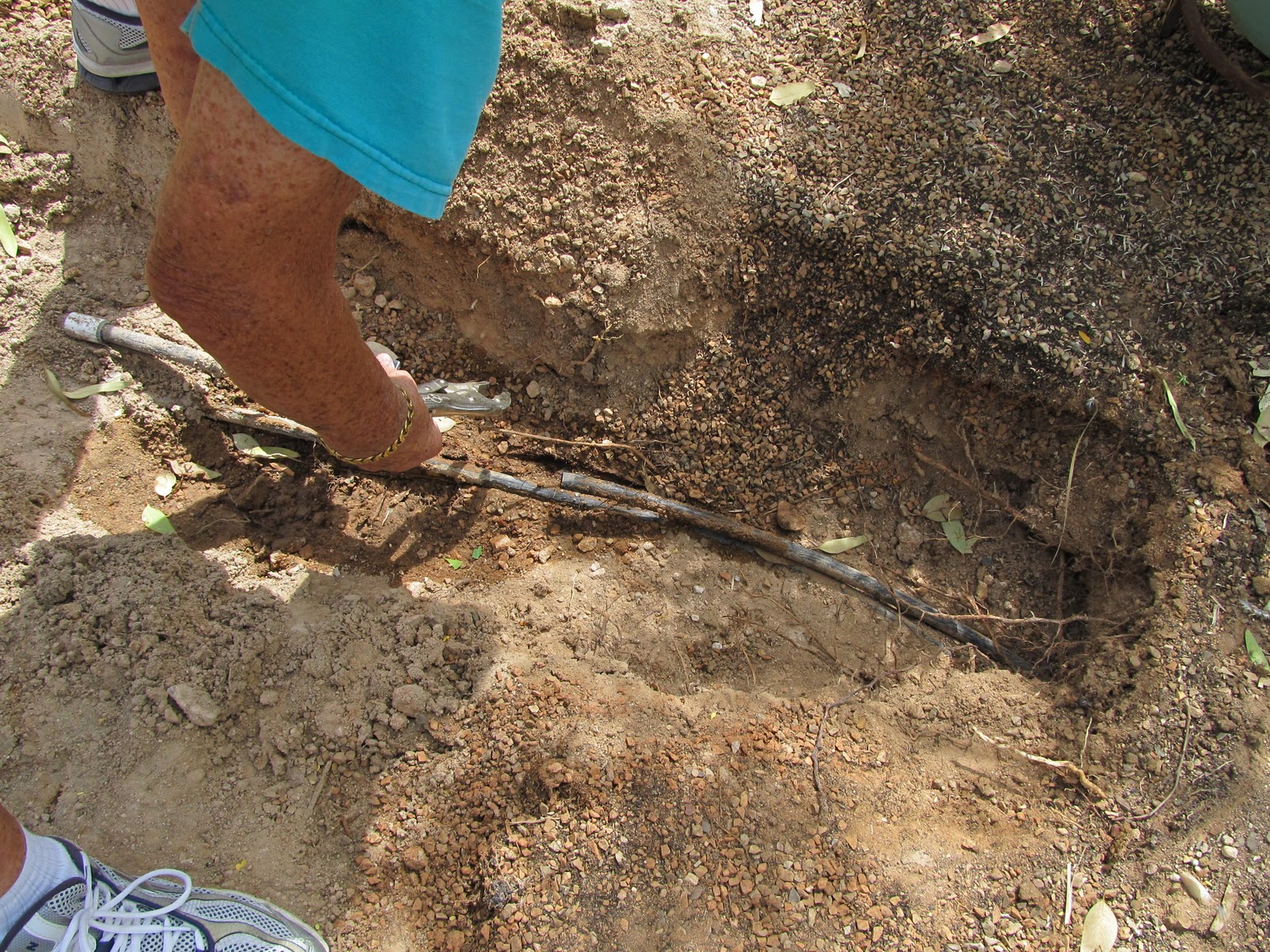

In the process of trying to figure out which system the leaking pipe served, Jay was using the timer controller to manually turn on each system, when suddenly the display flashed ERROR and then went blank.  Great.  It's never just one thing that goes wrong.  Must have multiples.  He was able to jury-rig the system to make it run, while figuring out that he could send the defective one to the factory for repair under warranty.  Well, that was one bit of good news as a new controller is about $120.  Although the weather is cooler and the water demands are down, the days will be warming up again into the high 80's next week.

That little bit of distraction took my husband away from his other current project - refinishing the two aging park benches which have succumbed to the harsh desert sun.  He replaced the old oak slats with that 'wood' made of recycled plastic bags, and painted the metal portions.  Voila!  A brand new bench.


Take a rest in your garden and enjoy the fabulous fall weather!

Tuesday, September 20, 2011

Back Yard Tales

If you think you have to go somewhere to enjoy nature, think again - about your back yard.  I am constantly amazed at what goes on out there, and often wonder how many cool things happen that I never see.  What birds stopped by?  What reptile slithered through?  Wouldn't it be fun to have a camera so you could see the otherwise unseen goings on?

Take the Gila monster for example.  He lives underground for perhaps 90% of his life, coming out for short forays a few times a year for food and a mate.  What are the chances of actually seeing one in the wild?  Very low, and yet, just about every year, sometimes more than once, we have had the great pleasure of observing this beautiful creature. And on one very special occasion, we even had two.  Gila monster babies we were hoping for.   But, so far, no visits this year.  My next door neighbor, however, recently had a Gila monster visit her patio as she was enjoying her morning coffee.  Gila monsters are the only venomous lizard in the U.S., but their slow movement and their lack of aggression give humans little cause for fear.  Other very occasional visitors include a beautiful king snake and Western diamondback rattlesnakes.  Gopher snakes, too, sometimes make an appearance.

Since ridding the yard of the packrat houses, the snakes have fewer reasons to come calling.  Packrats, or desert woodrats, a favorite meal for snakes, build a large, messy-looking mound out of cactus parts, sticks and other debris.  They also collect shiny or interesting little objects that might be lying around the yard.


No matter the time of year, the bird life is always abundant in the back yard.  Whether it be the regulars, (Gila woodpecker, cactus wren, Gambel's quail, mourning dove, house finch, phainopepla, northern cardinal, pyrruloxia, lesser goldfinch, Costa's hummingbird, Anna's hummingbird, white-winged dove, Cooper's hawk, red-tailed hawk, black-tailed gnatcatcher, verdin, white-throated swift, curve-billed thrasher, turkey vulture) the not-so-regulars (great horned owl, Western screech owl, northern mockingbird, kestrel, zone-tailed hawk, ladder-backed woodpecker, white-crowned sparrow, common raven, lesser nighthawk, Harris' hawk, greater roadrunner), or the migrants just passing through town (yellow-rumped warbler, black-headed grosbeak, western bluebird, Lucy's warbler, black phoebe, rufous hummingbird, black-chinned hummingbird, Bullock's oriole, western tanager, Wilson's warbler, lazuli bunting, yellow warbler, American robin, hooded oriole), they keep me continually entertained.  Right now I have a juvenile male Costa's hummingbird that waits every morning for me to fill the feeder that has been emptied overnight by the nectar bats.  He sees me bringing the feeder out of the house and flies right up to my face, as if to say, "about time!"  Impatiently, he begins to drink while the feeder is still in my hand.  

Everywhere I walk in the yard, lizards, big and small, scurry out of my path.  There must have been a good hatch this year, because the really tiny lizards are especially numerous.


These little guys are less than 2" long from nose to tail tip.  They both appear to be young desert spiny lizards and will look like this when they grow up:


The other day I saw one big male munching happily away on my blackfoot daisy blooms, picking off one whole flower after another.  Can't you guys stick to insects?? When it rains it's hilarious to see them racing around the patio grabbing ants or other little insects.  

I've been watching a bud grow longer and longer on a funny little cactus in my garden.  This morning this sight greeted me:

Another surprise was the emergence of a leafy plant in pot containing a silver torch cactus.  A weed?  Let's wait and see.  Soon buds began to form and yellow flowers emerged.  Aha!  A devil's claw (Proboscidea althaeifolia).  But how did it get here?  Oh, of course.  I often pick up the interesting seed pods that give the plant its name as I'm walking in the desert.  Long ago I stuck one of the opened seed pods in this pot and apparently it hadn't disbursed all its seeds yet.


The night blooming cereus (Peniocereus greggii) which bloomed in June is now full of bulging, ripening fruit, turning from green to red.


I have yet to try starting a new plant from seed.  This must be the year to do it.  I'd better get to picking, however, before the animals beat me to the fruit.  Anything edible in the desert doesn't last long.

A year or so ago, I planted a lovely group of Mexican fence post cactuses (Pachycereus marginatus) and they've been doing so well.  Suddenly, I began to see large scars where obviously something or someone was chewing on them.


 I had an idea who it might be, and, sure enough, soon I began to see the culprits feeding on other nearby cactus.


These handsome bugs are longhorn cactus beetles who have a taste for the finer things in life.  The more you have paid for a cactus, the greater their enjoyment of it.  Thanks a lot, guys.

The hummingbirds seem to have more than their share of competition for the nectar in the feeders these days.  The little birds themselves are highly territorial and competitive for feeding spots, but now they also have to compete with the bats, bees, ants and woodpeckers.  Nectar bats come every night to empty the feeders.  As soon as I fill them in the morning, the bees arrive to get their fill. Soon a stream of tiny ants descends for some of the sweetness.  As if that weren't enough, the Gila woodpecker sticks his beak and long tongue into the tiny holes for his share of the nectar.


Cooper's hawks are daily visitors to the yard, looking for an easy meal of dove or quail, often perching in an old dead tree before coming down for a drink from the water bowls, or resting on the patio furniture.  Sometimes they will just stand in the water bowl, cooling off their feet.  A rapid swoosh of wings as all the birds in the yard take off tells me that Coop is in the area.


But the really big thrill is when a bobcat strolls nonchalantly by the back door, only a foot or so from the floor-to-ceiling window, and stops for a drink of water.  He drank from two bowls, walked slowly to the wall and effortlessly hopped up to the top and over.


"Back Yard" could mean anywhere around your house or your neighborhood.  Wherever you live, nature is there too.  Take a little trip into the world of nature in your back yard.


Sunday, September 4, 2011

The Endless Summer

Or so it sometimes seems in Tucson.  And it's not necessarily a good thing.  By the time September rolls around, we've had just about all this fun we can stand!  Some desert denizens, however, can't get enough of the heat.  Take the short, stubby barrel cactus.  By the first of September, it is just coming into it's glory days, blooming long after all the other cactus species, thus sharing its fame with none of them.  I showed you some of them last month, but can't help taking more photos.

All of these and many, many more were in bloom at the Desert Museum on Friday.  I particularly love the barrels with the super-long spines, but I wouldn't want to try to plant one.


 Cactuses have wide, shallow roots to gather as much moisture as possible from the desert surface, where pounding rains often send water racing across the land, not allowing it to soak in.  The moisture is then stored in the fleshy body of the plant where it is protected from transpiration by a waxy skin and special photosynthesis called CAM.  The spines do their job of keeping the predators at bay.  Ground squirrels and even deer will brave the spines to eat the bitter-tasting fruit and help disperse the seeds.  Cactus flowers are what primarily define the family.  All have many stamens and a multi-lobed stigma.  Native cactus bees are the primary pollinators.

********************************************************************************
The white-winged doves have left town, a sure sign that summer will eventually be over.  I won't miss their greedy monopoly of the bird feeders.

And now the nectar-feeding bats have arrived to nightly empty my hummingbird feeders.  They are readying for their long migration to Mexico later in the fall.  It's quite amazing how these little creatures can find such a nectar source in this urban environment, flying many miles each night from their day roost in mountain caves.

Two species of bats spend the summer in southern Arizona - the Lesser Long-Nosed and the Mexican Long-Tongued.  To my knowledge, I've only ever had Lesser Long-Nosed at my feeders.  It seems as though very little is known about the overall roosting, mating and foraging habits of these bats, but recent and continuing studies are changing that and providing a clearer picture.  For several years I have participated in a monitoring program which records data from many volunteers regarding the bats' feeding habits at the hummingbird feeders.  Generally, the bats begin arriving around the middle of August and come nightly until sometime in October.  The darkness and the rapid movement of the bats combine to make it difficult to count or photograph them.

********************************************************************************
Our summer getaway took us to the White Mountains of east central Arizona, where the high country offered green meadows, cool temperatures, daily rain, wildflowers, and, on the sad side, a look at the devastation of the recent huge Wallow Fire, the largest in Arizona's history.

For the entire photo album, go to White Mountains Photos

******************************************************************************
Next up was a too-brief trip to Reno, mainly so I could attend the funeral service of my Uncle Rich, my mother's younger brother, and to pay tribute also to my Aunt Grace, another of the siblings, who also recently passed away.  Of the five children of Thad and Amy Bath, my grandparents, only the eldest son survives.  Adin, California, just over 150 miles northwest of Reno, was their hometown and where the service was held.  Despite the sad occasion, it was good to see so many cousins and their families.  Having spent every summer vacation and every school holiday on the family ranch in nearby Ash Valley, a visit to this magnificent country brings back so many memories.


In Reno, my sisters and I celebrated our August birthdays with a dinner at Zagol, an Ethiopian restaurant.  It was fun and delicious, and we had some good laughs over the strange, sponge-like bread that is used in place of utensils to scoop up the food.


More photos at Reno and Ash Valley Photos

******************************************************************************

Here's to summer! Yes, even the Tucson summer.


Thursday, August 4, 2011

Musings on an August Morning

The dog days of summer have arrived, when Sirius, the dog star and the alpha star in Canis Major, rises in the morning, chasing (or being led by?) Orion across the sky all day.  The August days are sultry, as my grandma would say, hot and sticky. 

Since the beginning of the monsoon in the Sonoran Desert, many of us have been waiting, more or less patiently, for that defining storm, when the lightning puts on a spectacular light show, the thunder cracks and rumbles in a near constant roar, and the rain comes down in buckets.  It finally came, two nights ago, unpredicted and unexpected, and oh, so wonderfully welcome! 

It takes a really good rainstorm to bring out the flying ants.  Sure enough, there they were this morning in a huge column over my patio, mating in the air and falling to the ground, there to be snapped up by the feasting lizards, finches and quail.  The quail parents brought their young family to the buffet and they ate like typical growing kids.  On my walk around the neighborhood I must be sure to wear sunglasses and to keep my mouth closed! 

Also responding to the moisture in the soil, a desert millipede (sometimes called a rainworm) emerges to go exploring, looking for .  .  .  what?  Food, a mate?  I’m not sure, but I’m always happy to see the strange little creature with a hard, rounded body and so many, many legs.  Each of its many segments has two legs, and a new segment is added each time the millipede sheds.  Known as detritivores, millipedes forage for decaying organic material and are good burrowers. 

               Agave 8.4.11 026       Agave 8.4.11 031

As I greeted the morning birds in the yard and had a word with all the plants, complimenting them on their lush vegetation, I heard a familiar hoarse screech and looked around the for the hawk I knew must be nearby.  Just down in the wash behind my back wall there sat a Harris’ hawk on top of a saguaro, calling and calling.  These social birds are generally seen in groups, so I quickly scanned for more hawks, but never saw any.  This appeared to be a young male, though I admit that’s mostly a guess. 

                          Agave 8.4.11 012  Agave 8.4.11 015
Just a few evenings ago, two Harris’ were sitting in a big dead snag in my yard, possibly this same bird and one of his siblings, both of whom may have been from this year’s hatch.

ASDM 7.29.11 002
The fat barrel cacti (Ferocactus wislizenii) celebrate August with glorious blooms in a warm palette of colors from red to yellow.

                 ASDM 7.29.11 031 ASDM 7.29.11 039
Agave 8.4.11 005
Agave 8.4.11 017  A broad, flat central spine curved into an arc gives this cactus it’s nickname of fishhook barrel, and the propensity of the elongating barrel to tilt toward the southwest has led it to also be called compass barrel.  I don’t suggest you cut it open to quench your thirst in the desert, however.  That’s a myth perpetrated by John Wayne and Western movies. 

Ocotillos wear their green robes so elegantly, and limberbush, the ultimate monsoon plant, puts on leaves before we have a hint the monsoon is coming, and doesn’t lose them until it’s sure the monsoon is over.  These plants are so smart!  The fruit of the prickly pear ripens to a lustrous deep red, drawing birds and small mammals to its sweetness. 

                  Agave 8.4.11 008 Agave 7.30.11 004

A big black bird floats lazily over the landscape, it's two-toned wings tipped up in a dihedral - turkey vulture, right?  No, Jay says, it's the zone-tailed!  I grab my binoculars for a closer look and, sure enough, there is the tell-tale white band across the tail that tells me this is no turkey vulture.  The zone-tailed hawk has been hanging around our neighborhood for a couple of months, and what a magnificent sight he is!  This time he is carrying some little prey species but he doesn't seem intent on landing or settling down for the meal.  He flaps his wings a couple of times and disappears from my sight.  Zone-taileds (Buteo albonotatus) don't often live in urban areas and they are a rare sight here in Tucson, so how privileged are we?

Floating around in the pool, I paddle over to the thermometer to check the water temperature.  Something in the rope-holder catches my eye.  Closer inspection reveals .  .  .  a mouse!  He's alive and he's hanging on for dear life in that little cavity where he can still get air.  The waves I've been creating don't make his life any easier.  I try pulling him out by his tail to rescue him, but he is clinging too tightly.  OK, I'll try grabbing him by his rear end.  I have to really pull to get him to release his hold on the bar, and I'm afraid he's going to turn around and bite me.  So, I quickly pull him loose and toss him unceremoniously over the side.  He lands in a little trough that runs between the pool deck and a rock wall, stunned and soaking.  Slowly, he looks around, discovers he's alive and on dry ground, and he proceeds to get cleaned up, sniff the new surroundings, and high-tail it out of there.

To top it all off, August is the Birthday Month in my family.  Happy Birthday to us, McNeall girls!  Celebrate the season, whatever your reason.