Phainopepla

Phainopepla
Phainopepla

Wednesday, November 9, 2011

In Search of Color

The desert has a powerful, fulfilling beauty, spiritual and deep.  But what it does not have is the glory of autumn leaves in the throes of their annual ritual of changing color. For those of us who have lived in parts of the country dominated by deciduous trees, where 'going to see the color' was a rite of fall, where even the drive to work took one's breath away with the stunning brilliance of the colors, there's just something missing when the days shorten and turn cool, pumpkins appear on doorsteps, Halloween arrives, and yet there are no 'colors'.


To fill this small void, I prodded my husband to drive up the Catalina Highway to Mt. Lemmon, in search of oaks, maples, aspens, sumacs in their fall colors.  It is a particularly fascinating ascent, biologically, passing through a number of life zones from saguaros and palo verdes to oaks and junipers, thence to pines, aspens, firs and spruce, from 2500' elevation to over 9000'.  The biological equivalent, they say, of driving from Mexico to Canada, in just 27 miles.

The Halloween day began prophetically with a colorful sunrise,


and a new bloom.

After a stop for breakfast, we made our way through Monday traffic across town, finally to the Catalina Highway, rising quickly above the congested valley, past the mega-houses carved into the granite hillside, and into the saguaro-studded foothills.  Before long, the vegetation became denser, the cactus giving way to yuccas, pines, oaks and grasses.  Massive rock formations and stunning views of Tucson and its surrounding mountain ranges greet the traveler at every turn.  A popular stop is Windy Vista where tourists snap photos and rock climbers test themselves on the granite outcroppings.


Crazy hoodoos look like people (well, kinda)

and I'm glad I'm not driving so I can enjoy this marvelous scenery.  Though I've seen it many times before, it never fails to inspire and entertain.  As we reached the higher elevations, a lookout offered a stark view of the mountaintop community of Summerhaven and its surrounding forests devastated by the Aspen Fire of 2003.

But color?  No there wasn't much yet. Here and there, a tantalizing touch of shining gold or yellow.


But, mainly it seemed we were a week or more too late for any big show.  Summerhaven is slowly rebuilding, and where once stood decades-old family cabins, now enormous new dwellings sit among a blackened forest of ghost trees.  Through the village we passed and on to the Marshall Gulch picnic area.  Several trails lead from this canyon area filled with deciduous hardwoods and dense lower vegetation along a small ephemeral stream.  Finally, here I was in a cathedral of color and silence.  

A carpet of maple leaves crunched under foot as I made my way along the trail.  The hammering of a woodpecker high in the canopy had me searching for the source.  Finally the movement drew my eye to a downy woodpecker, and then I could hear several of them.  Standing still, small bird sounds became louder and soon I saw movement all around.  Juncos, brown creepers and nuthatches were all busily preparing for winter.  


Shafts of sunlight made their way deep into the recesses of the canyon, lighting up the leaves, setting the colors aglow.  Small pools of water remained in the streambed, covered with a palette of orange, yellow, red leaves.


Bear with me if you see more striking colors every day out your window. I was in a momentary heaven and my camera felt the same, it just kept clicking and clicking.  The blue, blue sky above providing a magnificent backdrop to the forest.


The trail led on and I had to force myself to turn around as the light was fading and the mountain chill setting in.  

A handsome Abert's squirrel, with his pointed ears and bushy tail ran up a nearby tree to watch the passerby, carefully eyeing the black object being pointed at him.


Back on the road to Summerhaven, a white-tailed doe and buck strolled out of our way, not too concerned with the car.

At the Cookie Cabin's patio in the village, we gorged on freshly-homemade berry cobbler topped with ice cream, the biggest peanut butter cookie you've ever seen and a delicious cup of coffee.


Then it was back down the mountain.


Here's to days of beauty, peace, nature, and glorious color!

Wednesday, November 2, 2011

Friendship - From Virtual to Reality

In the cyberworld, we often meet people and become friends without ever meeting in person.  So when a fellow blogger recently told me she would be in Tucson and would I like to meet, I jumped at the chance.  After all, I already knew I would like her.  She leads an interesting and adventuresome life, which I admire, and she and I have so many interests in common.  Marilyn's stay in Tucson was brief as she was traveling from Texas to northern California and had only one night to stay.  So, we agreed to meet at Catalina State Park where she would be camping.  We could spend a couple of hours birding and then have breakfast before she had to be on the road again.


Before the sun even had an opportunity to rise over the Catalinas, we were on the trail.  Even before the birds, as it turns out!  We were so busy chatting and getting acquainted that we really forgot to notice how few birds were about.  It was a crisp morning, still chilly in the shadow of the mountains, but cloudless and promising to warm up soon.

As the sun rose higher and the trail climbed, it was time to shed sweaters.  Soon we were stopping to investigate bird songs and photograph those fascinating plants, not just the giant saguaros, but also cholla loaded with fruit.


A recently deceased saguaro, possibly the victim of lightning as there were some still-green parts lying among the debris, provided more photos ops.  The boots formed by the cactus to protect itself from the woodpeckers' nesting efforts were still embedded in the wooden ribs and decayed flesh.


Marilyn has great experience and knowledge of Texas flora and fauna and we enjoyed comparing the Sonoran Desert species to those with which she is more familiar.  In some cases, those species which overlap were much smaller in our drier climate.  Hackberry trees, for example, and side-oats grama grass.


Woopeckers called and flew by in their typical dipping, flap-flap-glide pattern, and we were able to recognize Gila and ladderback as well as flickers.  Many sparrows were flitting among the trees and shrubs - white-crowned, black-throated and rufous-sided.  They were joined by canyon  and green-tailed towhees.  A lovely little song made us think we might be hearing a wren, possibly a  rock wren, but we were never able to spot the singer.

Marilyn's road ahead was long and she wanted to be traveling before it got too late.  When we came to a fork in the trail, we could have gone left back to the parking lot, or right to take the 2-mile-or-so Canyon Loop trail.  Well, she said, that won't take long, let's take the loop trail.  Off we went, vowing to move faster and stop for fewer photos.  Ha!  Our intentions were good, but oh! there were just too many cool things to see.  Down by the ephemeral stream where tiny water cachements remained, the butterflies were flitting about - southern dogface, sleepy orange, queen, blues, Empress Leilia and gulf frittilaries.  Yellow composites bloomed, as well as a little purple aster (fleabane?) and some yellow primroses.  The deer grass was beautiful.


Just one more photo!
Oh, there were lizards too, scampering just out of camera view, and dragonflies.  Stop, she said, don't tell me any more.  Shorts and more water would have been in order at this point, but we were almost back to the car, weren't we?


We heard a black-tailed gnatcatcher and some Gambel's quail that refused to show their faces.  Marilyn really wanted to see the quail, and if we'd had more time, we could have found them.  These wonderful little birds are so evocative of the Sonoran Desert.  

The trail came to and end and we were off to breakfast.  Coffee and omelettes with salsa really hit the spot after our walk. It was a great morning and I'm so glad that Marilyn and I could make this connection.

 Here's to Marilyn's new adventure in a northern California wildlife refuge, and here's to friendship!


Wednesday, October 26, 2011

A Day in Happy Valley


 My birding group made its monthly outing yesterday, and our destination this time was Happy Valley, on the east side of the Rincon Mountains.  Seems somewhat silly to call ourselves a birding group when we look for and at so many other interesting things.  Maybe ‘naturalist’ group would be a better description.  For many miles along the dirt road we birded from the cars as Private Property signs were posted along both sides.  A juvenile Northern Harrier caught our eyes as he hunted low along the ground, many sparrows flitted among the trees, a Loggerhead shrike stood tall on the top of a mesquite tree, and Western Meadowlarks hopped from the ground to the low trees, singing their beautiful song.  That sound always takes me back to my childhood on my grandparents’ ranch in Ash Valley, California, where I would often awake to the song of meadowlarks.  A red-shafted northern flicker flew by.  As we rose in elevation, oaks and junipers joined mesquites as dominating species.  Along the ephemeral stream bed, the big cottonwoods, sycamores, willows and ash trees rose tall and offered a touch of fall color.


An unfenced area beckoned to us and there didn’t appear to be any NO TRESPASSING signs, so it was time for some exploration.  Grasshoppers were abundant here, as Buzz, our resident entomologist, had hoped, including large plains lubbers mating, beautiful red-wingeds flying, and another mating pair caught in the web of a black widow spider.  As the grasshoppers struggled to get free, the spider kept making jabs at them, but acted nervous and fearful of getting too close.  Quite the drama.  There were a few flowers blooming - morning glories, caltrops, threadleaf groundsel, scarlet creeper and some kind of vetch.  Birds included mockingbirds, red-naped sapsucker, a red-tailed hawk, a raven, yellow-rumped warblers, sparrows, Say’s phoebe and a Western wood pewee.  In the butterfly category, we saw queens, a variegated fritillary, pipevine swallowtails, sleepy oranges, cloudless sulphurs, and more.  Debbie found a very small set of antlers, long-since discarded by a white-tailed deer.  Did all that make up for the horrible stickers we  got in our shoes, socks, pants and legs??  Just as we were leaving, a woman came along and asked us to leave as we were on private property.  Fine. I couldn't wait to get out of those stickers anyway!


The caravan proceeded slowly as there seemed lots to stop and see - grasshoppers, butterflies, birds, plants, lizards.  Along the way a red-tailed hawk posed on a dead snag, frightening a large group of small birds that Gay was able to identify as lark buntings in winter plumage.  A bank of clouds advanced steadily until the sky was mostly cloudy, and looking somewhat like rain.  White-crowned and black-throated sparrows got the cars to stop for a closer look.  I could hear the white-crowned’s musical song.


Finally we arrived at Forest Service land and after a few minutes to study the maps, chose a road to Turkey Creek where we parked and had lunch at a large cleared campsite.  Up in the big trees, a chatter of small birds revealed yellow-rumped warblers.  An American robin and red-naped sapsuckers were all happily foraging in the juniper tree right over our heads.  Down the road we walked on a lovely fall day, the clouds keeping the temperature quite pleasant.  Some bird activity attracted our attention to a big sycamore tree, and Wow!  We found a bonanza!  White-breasted nuthatches, bridled titmouse, ruby-crowned kinglet, yellow-rumped warblers, all so busy.  So many fascinating little things to see, like a mantid egg case, a perfectly rounded bird nest with the entrance hole on the end, a shrine made of native rock, green cane chollas decorated with their bright yellow fruit.   Magnificent, giant trees amazed us with their huge girth and height.  One long-ago-fallen giant was like a sculpture, so lovely were its patterns and designs.  A red-tailed hawk rode a thermal, seeming to sit perfectly still on the wind.  The big leaves fell like snowflakes and crunched under our feet.  An interesting array of beetles and other small creatures hid under rocks, or so they thought!


Walking back to our cars, we felt a few raindrops, but that was the extent of the rain.  It had been a perfect day for ‘naturing’ !


For all the photos, go to  Happy Valley Birding

Sunday, October 9, 2011

This Week in the Garden

Plant sales.  I am unable to resist them.  And this is plant sale season in Tucson.  So when the Desert Museum had their sale recently, of course I had to go.  The line of people already waiting to pay for their purchases almost made me give up before starting.  But, we had driven all the way out there, and there were some wonderful plant specimens, so we soldiered on.  Three cacti and one passionvine later we were in line, Jay and me and my fellow docent Mary Lou.  About that time one of the Botany folks came along to write up our purchases and advise us that there was a separate cash line.  I went off to investigate, leaving the others to hold down our place in line, just in case.  How nice to discover not one person in the cash 'line'!  We were out of there in no time.

These new cactus specimens, plus two others that my friend Marilyn had given me now necessitated expanding my Small Cactus Garden, (cactita?) an area under an expanding blue palo verde tree that provides them some important filtered shade so they can survive the Tucson summers.  Jay helped me lay it out, mix sand and soil, fill the designated area and line it with rocks.


The new additions include two Coryphantha elephantidens from Marilyn, two Trichocereus (trichocerei?) which  will hopefully be two different color blooms, and one Hecho cactus with two stems.  The Hecho may have been a mistake as it does not like cold, and if it does do well, it gets huge.  So, we'll see about that.  The Trichocereus (hybrid torch) produce the huge, glorious blooms that just take your breath away.  Joining these new friends in the garden are two small pots - one with a variegated agave and the other with another Coryphantha species that is about to bloom.  The agave really should be unpotted (is that a word?) and put in the ground where it can spread its roots and grow.

The poor passionvine still sits in its nursery pot, waiting for its new home, which, at this writing, is still under discussion.  I'd like to plant it in the front courtyard on the shady side, with a trellis that will show off it's glorious purple blossoms.  And, it's looking rather ragged at the moment as I discovered several gulf fritillary butterfly caterpillars munching happily away on foliage and flower.  And, not two days after bringing it home, an adult gulf fritillary came to visit the passionvine and, if I"m lucky, deposit her eggs.  After all, the attraction of these spectacular butterflies is one of the main reasons to own this species.


Another reason, of course, is the beautiful flower, which sometimes also gets eaten by the voracious larva.

One of the caterpillars evidently decided it was time to go and find a place to spin its chrysalis as it took off and made it's way along the garage wall.


The same day, this handsome fellow was spotted, also on the garage wall, but in a different vicinity. It seems that I see a walking stick here about once a year.  Where do they go the rest of the time?


Hard to see, huh?  No wonder I rarely see them.  My husband gets credit for spotting this one.

The golden barrel has decided to bloom again.  This is a species (Echinocactus grusonii) native to Mexico, but widely grown in landscape in the Southwest.


Here are a few other blooms from the garden.

And speaking of caterpillars, I was happy to find some giant swallowtail caterpillars on my sad old lemon tree leaves.  The poor, ancient tree was on its death bed, and then along came the big freeze of 2011 and that was the final death knell.  We cut the tree down, intending to replace it with something more native, but have yet to dig out the stump.  New leaves are emerging, just the place for a giant swallowtail to deposit her eggs.  


If you were a bird looking for a tasty morsel, you would most likely pass this caterpillar by, resembling as it does just some bird poop.  Pretty good camouflage idea.

Passing by a foothills palo verde tree in the yard, something caught my eye.  A little closer examination revealed the egg case of a praying mantis, a lovely little object that looks as though it were sewn together.

I'm not sure if these will hatch this fall or overwinter in this form.  I'll keep watching, and look forward to having some mantis nymphs.

Another small discovery, sitting on the flower of the yucca was this interesting little creature, a leaf-footed bug.

Now blooming in the desert is the amazing creosote bush (Larrea tridentata), the most drought tolerant perennial plant in our desert, and among the longest-living of all plants. The yellow flowers occur at various times, usually following a rain. The fruit is a small, fuzzy white ball. Many insects feed on creosote bush, but few mammals do, probably only the jackrabbit.


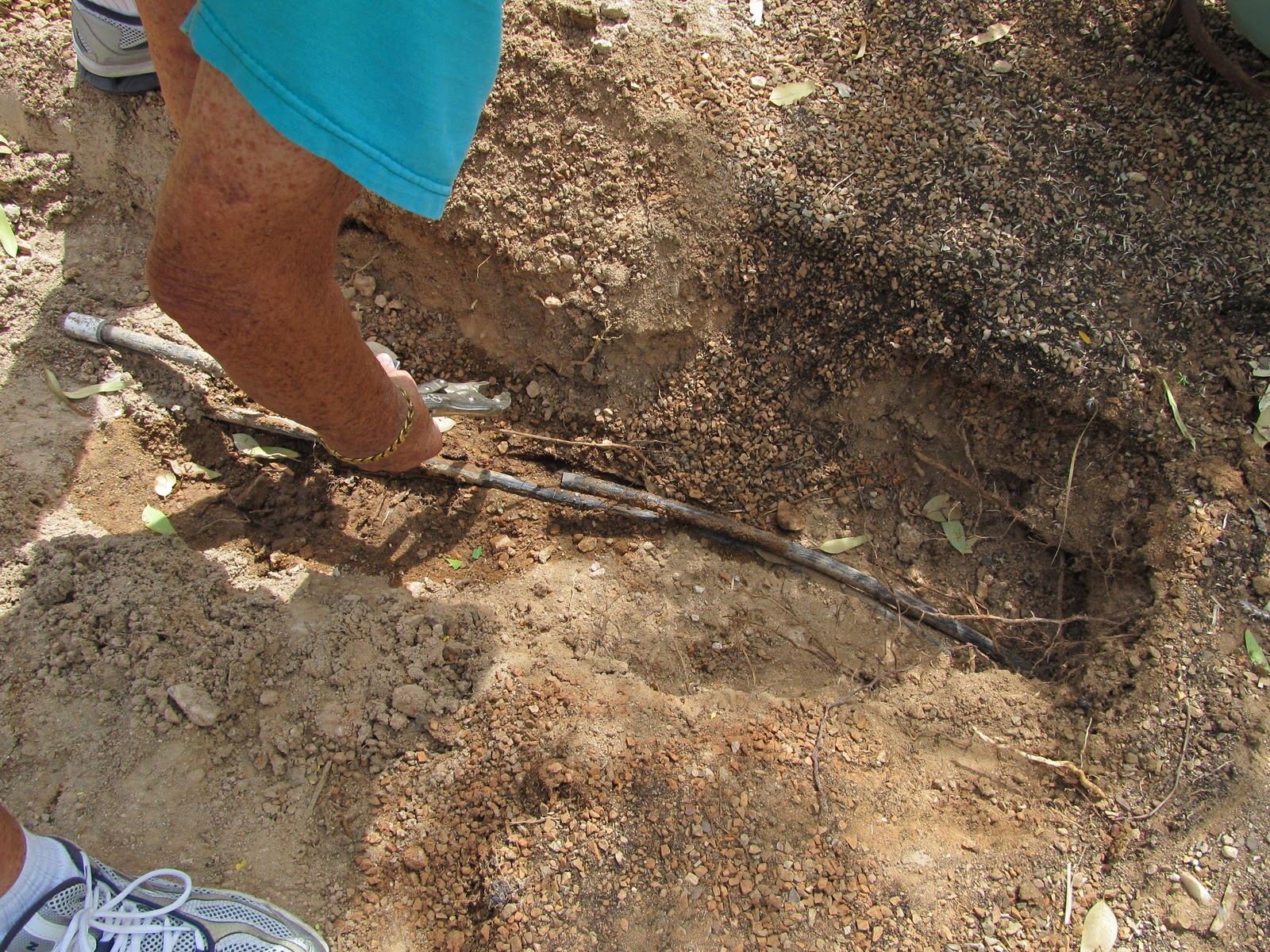
It was a Murphy's Law kind of day when I looked out the window and saw a small lake forming in the yard, water bubbling up out of the ground.  Repairing the drip irrigation is a constant, ongoing project.  We dug down to expose the pipes, about two feed under the pathway.


In the process of trying to figure out which system the leaking pipe served, Jay was using the timer controller to manually turn on each system, when suddenly the display flashed ERROR and then went blank.  Great.  It's never just one thing that goes wrong.  Must have multiples.  He was able to jury-rig the system to make it run, while figuring out that he could send the defective one to the factory for repair under warranty.  Well, that was one bit of good news as a new controller is about $120.  Although the weather is cooler and the water demands are down, the days will be warming up again into the high 80's next week.

That little bit of distraction took my husband away from his other current project - refinishing the two aging park benches which have succumbed to the harsh desert sun.  He replaced the old oak slats with that 'wood' made of recycled plastic bags, and painted the metal portions.  Voila!  A brand new bench.


Take a rest in your garden and enjoy the fabulous fall weather!